
How AI Is Changing Fraud Detection in Banking
Ask any fraud team at a bank what keeps them up at night, and the answer has changed. It used to be about catching the obvious cases: stolen cards, cloned accounts, the kind of fraud that leaves a clumsy trail. Now the harder problem is the fraud that doesn't look like fraud at all: a genuine customer, on their own device, willingly transferring money to someone they believe they can trust.
That shift is why fraud detection in banking has stopped being a rules-based checklist and started looking more like an ongoing arms race, one where both sides are increasingly powered by the same underlying technology. This article explains how AI fraud detection in banking works, what results banks are reporting, and where the real challenges sit. For the wider picture of AI across financial operations, see our guide on Key Applications of AI in Finance & Accounting.
What Is AI Fraud Detection in Banking?
AI fraud detection in banking refers to the use of machine learning and related technologies to identify suspicious transactions, accounts, or behaviour that may indicate fraud, replacing or augmenting the fixed, rules-based systems that have long been the norm.
Rather than checking a transaction against a short list of predefined red flags, AI systems learn what normal behaviour looks like for a given customer, account, or network of accounts, then flag meaningful departures from that baseline. This allows detection to adapt as both customer behaviour and fraud tactics evolve, rather than requiring an analyst to manually rewrite rules every time fraudsters find a new angle.
An Arms Race, Not Just an Upgrade
The scale of the threat is well documented, and so is the gap in how banks have responded to it.
Source: Signicat, Battle Against AI-Driven Identity Fraud (2024)
The same report found that deepfake fraud attempts alone grew by more than 2,000% over the preceding three years. A separate Signicat analysis found that only 22% of financial institutions had implemented AI-based fraud prevention tools in response, a defence gap that set the stage for where the industry stands today.
More recent data suggests that gap has shifted shape rather than disappeared:
Put together, the picture has moved on from "will banks adopt AI fraud detection?" to a harder question: how many are deploying it with enough maturity to actually trust it under pressure?
The Difference Between Traditional and AI-Powered Fraud Detection
The shift from rules-based to AI-powered detection isn't a minor technical upgrade. It changes the fundamental logic of how suspicious activity gets identified in the first place.
The practical effect shows up most clearly in false positives: legitimate transactions wrongly flagged as suspicious. Rigid rules tend to flag many of them, which means friction for genuine customers and wasted time for analysts chasing dead ends. AI-powered systems do not eliminate false positives, but they aim to reduce them, and one major bank's reported result appears later in this article.
How AI Fraud Detection Actually Works
Under the hood, AI fraud detection comes down to one question: does this action fit what is normal for this customer? Behavioural biometrics is one of the clearest examples of how that question gets answered.
Behavioural Biometrics: Catching the “How”, Not Just the “What”
Traditional fraud checks ask what: correct password, correct device, correct location. Behavioural biometrics asks how: the rhythm of someone's typing, the angle they hold their phone, the pressure and speed of a swipe. These patterns are much harder for a fraudster to copy than a password, because they aren't something a victim consciously knows to protect.
Additional AI Fraud Detection Techniques
Behavioural biometrics is only one part of a broader toolkit. Three other techniques are commonly used alongside it.
Network Analysis: Seeing the Bigger Picture
Individual transactions can look perfectly ordinary in isolation, even when they're part of a coordinated fraud ring. Network analysis maps relationships between accounts, devices, and transactions to reveal patterns invisible at the level of a single customer: shared devices across seemingly unrelated accounts, or money moving through a chain of accounts opened within days of each other. It is particularly useful against organised fraud rather than opportunistic, one-off cases.
Anomaly Detection Without Predefined Rules
Rather than relying on analysts to define what suspicious activity looks like in advance, unsupervised learning techniques let a system learn what "normal" looks like for a given customer or segment, then surface activity that doesn't fit, without a human having predefined what "suspicious" means beforehand. This matters as fraud tactics change faster than rules can easily be rewritten: the system can adapt to new patterns without someone having to write a new rule for each one.
Real-Time Transaction Scoring
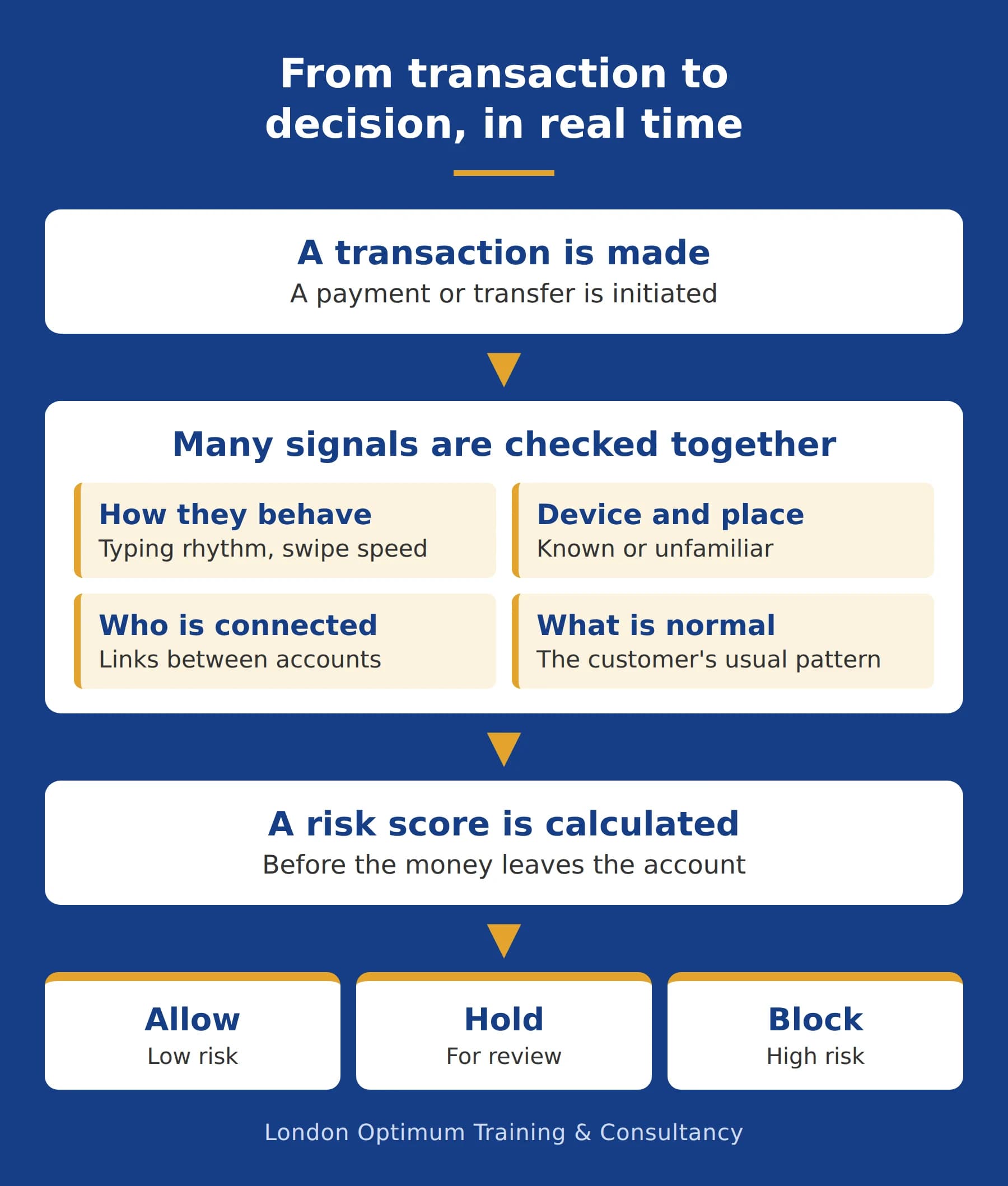
Batch processing, which reviews transactions in periodic sweeps, leaves an exploitable window between when fraud happens and when it's caught. Real-time scoring evaluates each transaction as it happens, weighing many risk factors in a fraction of a second. That allows a bank to block or hold a suspicious transfer before funds actually leave the account, rather than attempting recovery afterwards.
In practice, these techniques feed a single decision: a transaction is made, many signals are checked together, a risk score is calculated, and the transaction is allowed, held for review or blocked.
Real Results Banks Are Reporting
Some banks now publish concrete outcomes, and one of the clearest examples comes from HSBC, which co-developed an AI system with Google, known internally as Dynamic Risk Assessment, to check for financial crime.
Source: HSBC, Harnessing the power of AI to fight financial crime
HSBC says it checks about 1.2 billion transactions a month across 40 million customer accounts. Before the new system, it had a high number of false positives, meaning customers were being contacted unnecessarily about legitimate activity.
Two things are worth keeping in mind. This is financial crime monitoring more broadly rather than card fraud alone, and it is a result the bank reports for its own systems, so it is best read as an example of what is possible, not a benchmark every bank will match.
The point worth taking from it is that better detection is not only about catching more. Fewer false alarms matters just as much, for customer experience and for analyst workload alike.
The New Challenge: Authorised Push Payment Scams
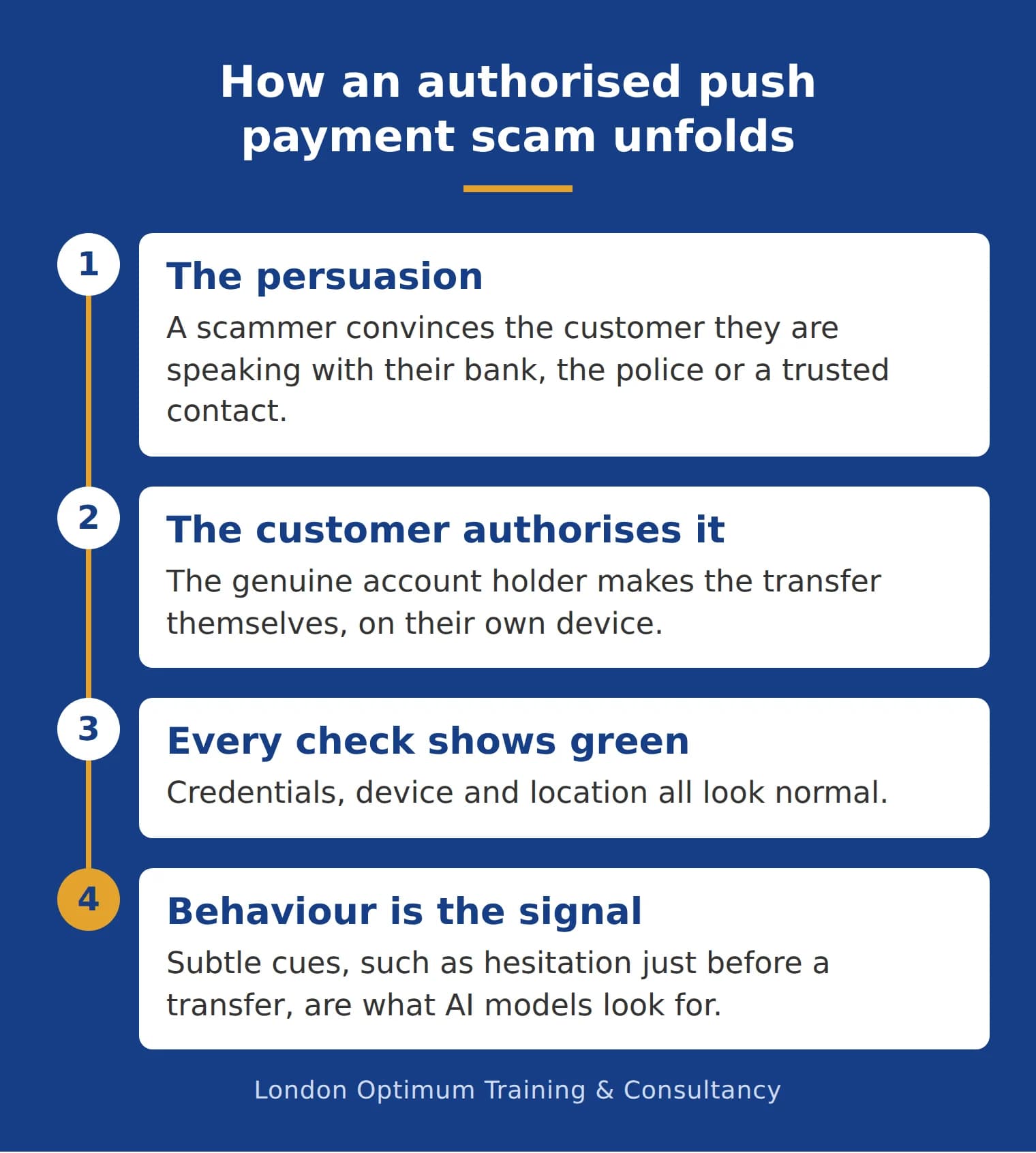
One of the hardest fraud patterns for banks to catch doesn't trip any traditional alarm at all. In authorised push payment scams, the legitimate account holder initiates the transfer themselves: correct device, correct location, correct credentials. Every standard security check shows green. The fraud happens entirely through persuasion: a scammer convincing the victim they're speaking with their bank, the police, or a trusted contact.
Catching this requires a fundamentally different signal than credential verification: subtle behavioural cues, such as hesitation immediately before a transfer or unusual activity around the payment. Fraud detection has to look beyond credentials and transaction data to how customers behave under pressure.
The sequence is consistent: persuasion, customer authorisation, checks that all look normal, and behaviour as the only signal left.
Agentic AI: The Next Shift in Fraud Detection
Over half of financial institutions are now piloting or deploying agentic AI — systems capable of taking action, not just flagging anomalies. Rather than simply alerting a human analyst, an AI agent can request supporting documentation, escalate a case based on risk thresholds, and refine its own detection logic over time without manual retraining.
In practice, this shifts AI's role from passive monitor to something closer to a continuous compliance auditor — reviewing transactions in real time and surfacing policy exceptions before they compound into larger problems.
Regulatory and Compliance Considerations
As fraud detection systems take on more autonomy, they also attract more regulatory scrutiny — and rightly so, given how directly their decisions affect customers' access to their own money.
The Explainability Requirement
When a system blocks a transaction or flags an account, banks increasingly need to explain why — both to satisfy regulators and to resolve customer disputes fairly. This is a genuine constraint on model design: the most accurate model isn't always the most explainable one, and banks often have to balance raw predictive power against the ability to justify a decision in plain terms. Our guide on AI Governance Training for Leaders covers this tension in more depth for leaders building broader AI oversight frameworks.
Data Privacy in Behavioural Monitoring
Behavioural biometrics, by design, involves collecting detailed data about how customers interact with their devices — information considerably more granular than a password or PIN. Banks need clear governance around how this data is stored, how long it's retained, and who can access it, particularly as data protection regulation continues to tighten around sensitive behavioural and biometric information specifically.
Guarding Against Algorithmic Bias
A fraud model trained on historical data can inherit and amplify whatever biases exist in that data — potentially flagging certain customer segments more often not because they're genuinely riskier, but because of patterns in how past decisions were made. Regular auditing for disparate impact across customer groups isn't just good practice; in many jurisdictions, it's becoming a regulatory expectation.
Challenges of AI Fraud Detection in Banking
Beyond regulation, AI fraud detection faces a distinct set of technical and operational challenges that shape how well it performs in practice.
Data Imbalance: Fraud Is Rare, By Design
Fraudulent transactions typically make up a tiny fraction of overall volume — good news for banks, but a genuine technical obstacle for training accurate models. A system trained on heavily imbalanced data can become very good at predicting "not fraud" simply because that's the overwhelming majority case, while missing the rare genuine positives it exists to catch. Handling this well requires deliberate technique, not just more data.
Adversarial Evasion: When Fraudsters Learn the Model's Patterns
Sophisticated fraudsters actively probe detection systems to learn what triggers a flag and what doesn't, then adjust their behaviour just enough to stay under the radar. This turns fraud detection into a moving target — a model that performs well today can lose effectiveness within months as fraud tactics adapt specifically around it, which is why continuous retraining matters as much as initial accuracy.
Integrating with Legacy Systems
Many banks still run core infrastructure built decades before modern AI tools existed. Connecting real-time fraud scoring to systems never designed for it is often a bigger practical obstacle than the model itself — an accurate model delivers little value if it can't act on a transaction before that transaction has already cleared.
Alert Fatigue and Analyst Trust
Even a well-tuned system generates false positives, and if the volume is high enough, fraud analysts can start treating alerts as routine noise rather than genuine signals — the same trust problem the industry-wide adoption statistics point to. Managing alert volume carefully, and clearly explaining why each alert was raised, matters as much for analyst trust as for raw detection accuracy.
What This Means for Banks Building Internal Capability
The picture this article has traced is worth pulling together directly: fraud detection is now the AI use case banks prioritise most, and adoption has become the norm rather than the exception — yet only a small fraction of institutions describe their deployment as genuinely mature. That gap isn't primarily a technology problem; the tools described above are commercially available. It's a capability problem: teams need to understand how these systems work, what signals they weigh, and how to interpret and act on what they flag, rather than treating fraud AI as a black box that either works or doesn't.
Closing that gap is exactly the kind of practical, applied capability our AI Fraud Detection in Banking course at London Optimum Training & Consultancy (LOTC) is built around — helping banking and financial services teams move past piloting and toward the kind of maturity that lets them deploy, oversee, and genuinely trust these systems.
For teams weighing AI adoption more broadly across financial operations, our guide on Key Applications of AI in Finance & Accounting covers the wider picture beyond fraud specifically.