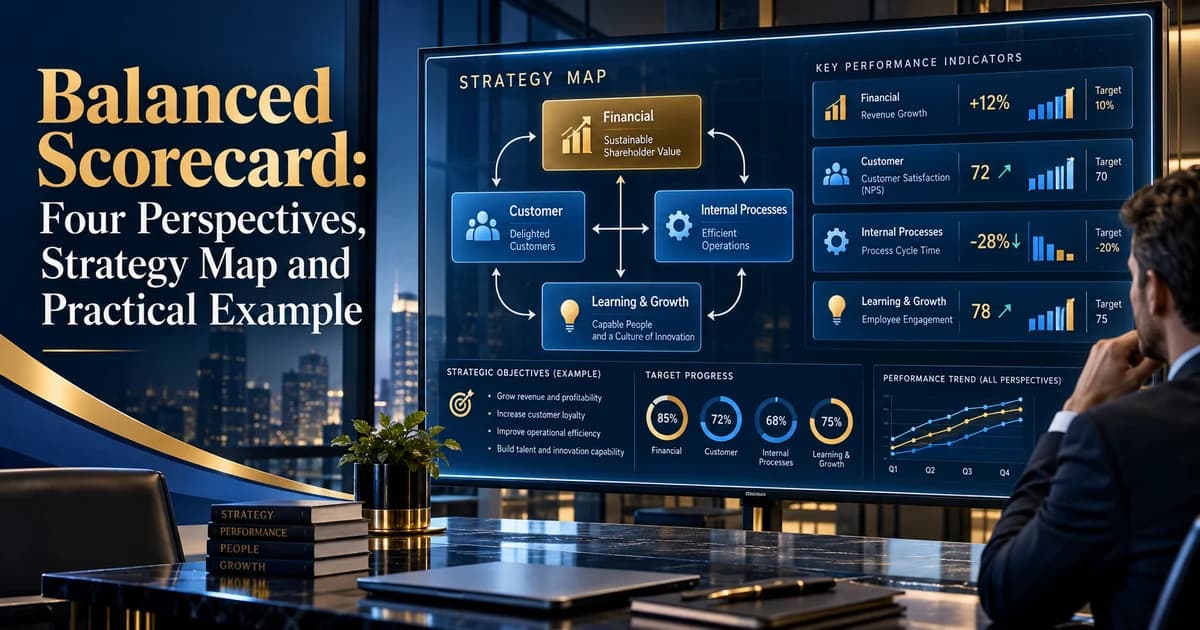
Balanced Scorecard: Four Perspectives, Strategy Map and Practical Example
Look at the monthly reports: productivity targets are green, yet customer retention is slipping. A balanced scorecard raises an uncomfortable question: are teams delivering the results the strategy actually requires, or simply meeting their own KPIs?
The problem may not be a shortage of data. Without a clear connection between daily performance and strategic outcomes, departments can look successful while the organisation moves in the wrong direction.
This guide explains the four Balanced Scorecard perspectives, how to build a strategy map, and how to choose meaningful KPIs and targets.
A worked example shows how these elements can guide management decisions, not just performance reporting.
What Is a Balanced Scorecard and How Does It Support Strategy?
A balanced scorecard is a strategic management framework that translates an organisation’s strategy into connected objectives, performance indicators, targets and initiatives across four perspectives: financial, customer, internal processes, and learning and growth.
A KPI dashboard shows how measures are performing. The balanced scorecard framework goes further: it explains why those measures were selected, which strategic objectives they support and how management should use the results. A dashboard containing financial, operational and customer metrics is not automatically a balanced scorecard.
Robert S. Kaplan and David P. Norton introduced the approach in Harvard Business Review in 1992 and developed its use as a strategic management system in 1996. While strategic planning sets the direction, the scorecard helps translate that direction into measurable priorities and regular management reviews.
The Four Balanced Scorecard Perspectives Explained
The balanced scorecard four perspectives help leaders judge whether the organisation is advancing its strategy, rather than simply improving isolated metrics. Each perspective answers a different management question:
-
Financial: What financial outcomes must the strategy deliver? For a subscription-based business, the objective might be to increase recurring revenue, not merely reduce this month's costs.
-
Customer: What value must customers experience? Improving customer retention could be more strategically important than increasing the number of sales enquiries.
-
Internal Processes: Which activities must work better to deliver that value? Improving first-contact resolution can reduce repeated customer enquiries and service delays.
-
Learning & Growth: What capabilities make better performance possible? Strengthening service-team skills, supported by suitable systems and knowledge resources, may enable faster problem-solving.
These perspectives are not four separate KPI lists. They are connected parts of the balanced scorecard framework: stronger employee capability may improve service resolution, which can support customer retention and, over time, recurring revenue. The relationships matter more than achieving a target in every department independently.
The emphasis also depends on the organisation. In government and non-profit settings, outcomes for citizens, beneficiaries or other stakeholders may take priority over financial returns, while responsible use of funding remains essential.
How Does a Balanced Scorecard Strategy Map Connect Strategic Objectives?
A balanced scorecard strategy map shows how strategic objectives are expected to contribute to one another. Rather than arranging goals into four unrelated categories, it makes the organisation's assumptions about value creation visible.
Consider a B2B service provider seeking to grow recurring revenue. Its strategy map could follow this sequence:
Learning & Growth: Improve service-team capability
Internal Processes: Improve first-contact resolution
Customer: Increase customer retention
Financial: Grow recurring revenue
The logic is practical: better-trained employees may resolve more customer problems on the first contact. A more reliable service experience may then encourage customers to renew, supporting recurring income. But each arrow represents a strategic hypothesis, not a proven causal relationship.
Suppose competency assessments improve while first-contact resolution remains unchanged. Managers should not immediately conclude that training was wasted—or assume the strategy is working because the training KPI is green. They should investigate whether employees are applying new skills, whether approval rules delay resolutions or whether inadequate systems are preventing progress.
The Balanced Scorecard Institute describes strategy maps as a way to connect objectives through cause-and-effect relationships. Used properly, strategy map examples like this one help leaders identify what to test, rather than presenting a diagram as proof that improvement in one area will automatically produce results elsewhere.
How to Create a Balanced Scorecard from Strategic Objectives
Build a balanced scorecard around what your strategy needs to achieve, not whatever data is easiest to report. Use four practical steps:
- 1
Clarify strategic priorities: Define the outcomes the organisation must deliver.
- 2
Map connected objectives: Show how capabilities, processes, customer outcomes and financial results may influence one another.
- 3
Choose KPIs and targets: Select measures that reveal progress towards each objective.
- 4
Assign initiatives and accountability: Agree who will act, what resources are needed and when results will be reviewed.
These practical steps simplify the Balanced Scorecard Institute's nine-step methodology.
Define Strategic Objectives Before Choosing KPIs
Start with a question: What must improve for the strategy to succeed? If the priority is customer retention, strengthening employees' problem-solving capability may be an enabling objective.
Counting training hours is convenient, but it tells you little about whether staff can resolve customer issues. A practical competency assessment may be more informative.
Use leading indicators to track expected drivers and lagging indicators to measure achieved results. Their classification depends on the objective: first-contact resolution can be an outcome of service improvements and a potential driver of retention.
Set Meaningful Targets, Initiatives and Accountability
For each objective, agree:
- Baseline: Current performance, measured consistently.
- Target: A realistic improvement and deadline.
- Initiative: The action intended to close the gap.
- Owner and review frequency: Who is responsible for examining progress and when.
Define each KPI's calculation and data source so departments are comparing like with like. Connect initiatives to resources through business planning and analysis. Otherwise, a polished scorecard can become an unfunded wish list.
Balanced Scorecard Example: Strategy Map, KPIs and Targets
Consider a fictional B2B services company whose customers subscribe annually. Recurring revenue is growing slowly, while too many accounts fail to renew. Its strategic priority is to improve customer retention and support sustainable recurring revenue growth.
The following balanced scorecard example follows the strategy map introduced earlier: service capability → issue resolution → retention → recurring revenue. All figures are illustrative, not company results or research findings.
Balanced Scorecard — Illustrative Example
Each measure answers a different strategic question. The competency pass rate indicates whether staff demonstrate the skills being developed, although passing an assessment does not guarantee improved service. First-contact resolution tests whether more customer issues are resolved without repeated contact. Customer retention captures renewal outcomes, while recurring revenue growth measures a financial result influenced by retention, pricing and new sales.
To make the scorecard usable, the company must agree on definitions. For example, specify which customer contacts qualify for first-contact resolution, and measure retention against a consistent eligible customer cohort. Assign a responsible owner and review schedule for every KPI; annual measures will not provide a meaningful new result every month.
What if the numbers disagree?
After three months, suppose the assessment pass rate rises from 60% to 76%, but first-contact resolution remains near 65%. Training results look promising; the expected operational benefit has not yet appeared.
Rather than adding more measures or declaring the training a failure, managers should inspect cases. Are staff using their new skills? Are approval rules preventing immediate resolution? Is the knowledge base difficult to access?
That investigation turns the balanced scorecard and KPIs into a management decision: remove a process bottleneck, improve tools or adjust coaching, then check whether resolution improves.
For teams developing this capability, LOTC's Strategic Planning with Balanced Scorecard course provides practical training in strategy maps and performance measures.
How to Review a Balanced Scorecard and Adjust Strategic Decisions
Review a balanced scorecard to decide what needs to change—not merely to colour a dashboard red or green. Effective performance management means examining both results and the strategic assumptions behind them.
At each review:
- 1
Compare performance with targets and trends. Check the latest result, direction of travel and whether an apparent improvement is sustained.
- 2
Test the links between measures. Are stronger capabilities translating into better processes and, eventually, better customer outcomes?
- 3
Agree on a management decision. Remove a bottleneck, redirect resources, adjust an initiative or investigate an assumption. Record the owner and next review date.
- 4
Refine the scorecard when justified. If priorities shift or a KPI no longer reflects its objective, revise it without changing definitions simply to improve reported results.
For example, faster issue resolution may coexist with flat customer retention. Before rejecting the strategy map, examine cancellation reasons, pricing changes and the time required for renewal decisions to emerge. Use operational KPIs to investigate service performance; reserve the strategic review for testing whether those improvements create the intended value.
Monthly operating updates and quarterly strategy discussions can be a practical starting point, not a universal rule. Kaplan and Norton's concept of strategic learning captures the principle: use evidence to test strategic hypotheses and adjust decisions accordingly.
Build Strategic Performance Management Capability with LOTC
The value of a balanced scorecard lies not in how many measures it tracks, but in the decisions those measures help leaders make. A strong scorecard challenges assumptions, reveals where strategic priorities are losing momentum and directs attention towards what needs to change.
Turning this insight into consistent management practice requires more than a reporting template. London Optimum Training & Consultancy develops these capabilities through its Strategic Planning with Balanced Scorecard course, covering strategy maps, the four perspectives, leading and lagging KPIs, target setting and strategic performance reviews.
When performance data is plentiful but strategic direction remains unclear, better measurement alone is not the answer.
Contact LOTC on WhatsApp to explore training that helps your leadership team turn strategic objectives into measurable progress and informed decisions.