Constructive Feedback at Work: SBI Model and Practical Examples
Tell an employee, “You need to communicate better,” and they may nod in agreement. A week later, the same client handover goes wrong. Constructive feedback was never really given: the manager expressed an opinion without identifying what needed to change.
Useful feedback identifies a specific behaviour, explains its impact and gives the employee an opportunity to respond not simply accept a judgement. That distinction becomes especially important when conversations feel uncomfortable.
This guide explains how to give constructive feedback using the SBI model, with practical workplace examples, ways to handle defensive responses and a clear approach to agreeing on improvements. The goal is meaningful change, not just a polite agreement.
What Is Constructive Feedback at Work?
Constructive feedback at work is specific information about observable behaviour and its effect on work, colleagues or results. Its purpose is to reinforce effective actions or help an employee improve performance.
It is not simply criticism. Recognising how an analyst clarified a client's concern can be as constructive as addressing an incomplete handover. In both cases, discuss what the employee did and what followed, rather than labelling their attitude or guessing their intentions.
Performance feedback identifies the behaviour and its impact; coaching can then help the employee explore solutions and build the skills to apply them. The two approaches complement one another but serve different purposes.
Making feedback part of everyday team leader responsibilities helps managers support development without relying entirely on formal reviews.
When and How Should Managers Give Feedback?
Giving constructive feedback starts with choosing the right moment, not drafting the perfect sentence. When the facts are clear, speak soon after the event while details remain fresh, rather than saving everything for an annual review.
Use a private setting for corrective or sensitive feedback. For positive recognition, consider the employee's preferences: public praise may encourage one person and embarrass another.
Check what actually happened before commenting. If the information is second-hand, ask questions first. If emotions are running high, arrange a calmer moment rather than forcing the conversation.
Gallup reports that 80% of employees who said they had received meaningful feedback in the previous week were fully engaged at work. This is an association, not proof that feedback alone caused engagement. For managers learning how to give feedback to employees, timeliness matters, but accuracy and respect make the conversation useful.
How to Give Constructive Feedback Using the SBI Feedback Model
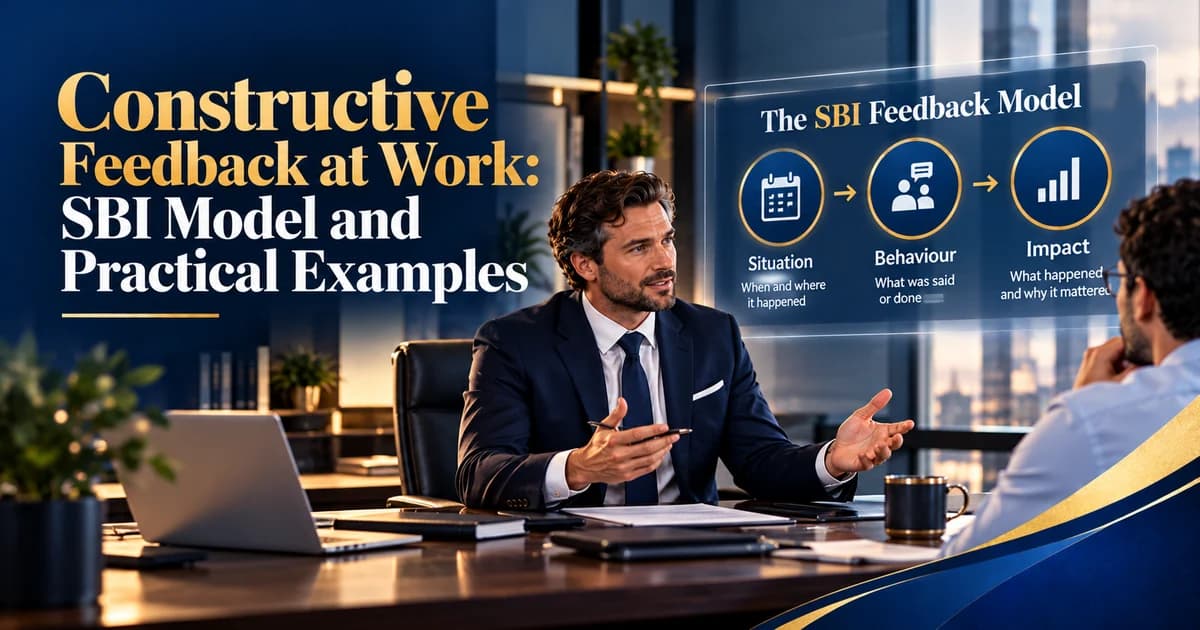
Use the SBI feedback model, developed by the Center for Creative Leadership, to describe an event without turning the conversation into a judgement about someone's character. SBI stands for Situation–Behavior–Impact and follows three steps:
- 1
Situation: Identify when and where the behaviour occurred. Refer to a particular meeting, task or interaction rather than saying “You always…”.
- 2
Behaviour: Describe what the employee actually said or did. “You interrupted the client twice” is observable; “You were unprofessional” is an interpretation.
- 3
Impact: Explain what happened as a result and why it mattered. Use evidence you can identify, distinguishing observed consequences from concerns that still need exploring.
Consider this workplace example. During Tuesday's client meeting (Situation), an employee closed the discussion without confirming who would handle the requested changes or when (Behaviour). Afterwards, two colleagues sought clarification, delaying the follow-up (Impact).
A manager could say:
“At Tuesday's client meeting, we ended without assigning an owner or deadline for the requested changes. Two colleagues then had to check who was responsible, which delayed our response.”
This is constructive feedback because it identifies an event the employee can recognise and a consequence they can address. The next step is to hear their perspective, not deliver a verdict.
Go Beyond SBI: Ask About Intent Before Drawing Conclusions
After explaining the impact, ask: “What was your thinking at that point?” Perhaps the employee was waiting for the client to confirm the scope. That context does not erase the missed handover, but it may change what a reasonable improvement looks like.
CCL calls this extended approach SBII, adding Intent to the original three elements. It turns feedback from a one-way statement into a discussion grounded in facts, context and shared understanding.
Constructive Feedback Examples: Weak vs Effective Feedback
Strong constructive feedback examples identify what an employee did and why it mattered. Unlike vague judgements, they give someone a behaviour to repeat or change. These illustrative workplace situations use the SBI approach.
Positive Feedback Examples That Reinforce Good Performance
Positive feedback should explain what made the difference. “Great teamwork” may feel encouraging, but offers little guidance. In the examples below, sharing client information helps resolve a problem, while clear reporting enables a timely decision. Both highlight contributions worth repeating.
Corrective Feedback Examples That Address Behaviour, Not Personality
Address the action, not the person's character. Interrupting a colleague and leaving a client handover incomplete require different improvements; calling either person “unprofessional” explains neither.
“Great teamwork.”
“During Monday's escalation call, you shared the client's account history with Support. That helped them resolve the issue without further clarification.”
“Excellent report.”
“Your Thursday report highlighted three overdue accounts and explained the causes. We could agree priorities without requesting another analysis.”
“You are disrespectful.”
“In today's planning meeting, you interrupted Maya twice while she explained the timeline. We missed part of her update and had to revisit it afterwards.”
“Your communication is poor.”
“At Tuesday's client handover, you left the requested changes without an owner or deadline. Two colleagues had to seek clarification, delaying the follow-up.”
These employee feedback examples replace general praise or criticism with observable evidence. A vague compliment can provide less developmental value than a precise corrective comment: one leaves the employee guessing, while the other makes the next action clearer.
Treat the impact you describe as something the employee can clarify, not an unchallengeable verdict. Ask what they observed before agreeing on what should be repeated or changed.
Giving useful performance feedback is part of the wider management skills needed to develop a team.
LOTC's Giving and Receiving Constructive Feedback course provides practical training in structured feedback, listening and difficult conversations.
How to Respond When an Employee Becomes Defensive
“That deadline changed twice. It wasn't my decision.”
An employee's defensive response may contain information the manager has missed. When learning how to provide constructive feedback, the priority is not to win the argument or withdraw the concern, but to establish what happened and what can improve.
Use three feedback techniques to keep the conversation productive:
- 1
Acknowledge: Let the employee explain without interruption. Recognise the pressure of changing deadlines without agreeing that no action was possible.
- 2
Clarify: Separate confirmed facts from assumptions. When did the deadline change? Who knew? Was there an opportunity to alert the team before delivery was at risk?
- 3
Refocus: Agree on the behaviour within the employee's control and the standard expected next time. Focus on early escalation rather than assigning blame.
For example, the manager might respond:
“You're right that the deadline changed twice, and I understand that affected your plan. My concern is that we only learnt about the risk on the delivery day. What would help you flag a similar problem sooner?”
The CIPD's 2024 research summary highlights listening and working relationships as important considerations in how feedback is received.
How to give feedback in difficult moments comes down to preserving both accountability and the employee's willingness to speak openly. The conversation should end with a clearer understanding, not an embarrassed concession.
Turn Feedback into an Agreed Improvement and Follow-Up
Acknowledging constructive feedback is not the same as acting on it. Close the conversation by turning the observation into a specific, realistic commitment that both people can assess.
Before you finish, agree on four things:
-
One behaviour to change: Choose a concrete action, rather than several vague expectations.
-
Evidence of improvement: Describe what successful performance will look like in actual work.
-
Support required: Clarify whether the employee needs examples, tools, training or a decision from someone else.
-
Review point: Set a date and decide what evidence you will examine together.
Return to the earlier client-handover example. Instead of asking the employee to “improve communication”, agree that their next two handovers will clearly record the owner, deadline and outstanding actions for each client request. Review both handovers at the next weekly meeting and ask what made the new approach easier or harder.
If the change does not happen, investigate before treating it as unwillingness. Is the employee unsure what is expected, missing a skill, short of time or blocked by unclear authority? Targeted coaching can help them identify a better approach; persistent serious performance concerns may require the organisation's formal performance-management procedures.
Good performance feedback creates accountability without ending the conversation at agreement. It gives both parties a practical way to tell whether anything has improved.
Strengthen Constructive Feedback Skills with LOTC
Constructive feedback is valuable not because a manager speaks more frankly, but because an employee leaves knowing what worked, what needs to change and what support is available.
For managers and supervisors, giving constructive feedback well takes practice: describing behaviour without judgement, listening when a conversation becomes difficult and agreeing on meaningful follow-up.
London Optimum Training & Consultancy develops these capabilities through its Giving and Receiving Constructive Feedback course, covering the SBI model, active listening, challenging conversations and continuous feedback.
The aim is to build a team where performance conversations lead to learning and better decisions, rather than defensiveness or vague promises.
Contact LOTC on WhatsApp to discuss practical feedback training for your managers and teams.