
In-House AI Training for Companies in London
What In-House AI Training in London Really Means
There's a common misunderstanding worth clearing up before anything else. In-house AI training doesn't mean building your own internal training capability. For most organisations, it means the opposite: bringing external expertise directly into the business, delivered privately, rather than sending employees to sit alongside strangers on a public course.
That distinction matters more than most companies realise before their first session. This article explains what in-house AI training in London actually involves, how it differs from an open course, and what to prepare so the programme delivers real value. For the general public-versus-corporate comparison, see our guide on Choosing the Right AI Training Program for Your Organization.
Source: Research.com, 2026 training industry statistics
In other words, most organisations have concluded that building world-class training expertise internally isn't worth the investment. What they want is that expertise delivered on their terms, inside their own walls.
In-House vs Public Training: What Actually Changes
Both formats serve real, distinct needs. The difference lies less in the quality of the teaching than in what the session is built around.
| What changes | Public course | In-house programme |
|---|---|---|
| Content | Designed for a mixed audience from different sectors | Built around your sector, tools and use cases |
| Examples | General business scenarios | Your own processes and challenges, where you choose to share them |
| Sensitive topics | Kept general, as other organisations are in the room | Can be discussed openly within your own team |
| Schedule and venue | Fixed dates at the provider's venue | Arranged around your team, at your premises or a venue of your choice |
| Who learns together | Individuals from different organisations | Your own team, building a shared vocabulary |
| Cost | Per person; the practical route for one or two people | Often per session; usually more cost-effective for a full team |
The practical question worth asking isn't "which is better," but "which matches what we're actually trying to achieve right now."
What Makes In-House Training Genuinely Customised
"Customised" is one of the most overused words in corporate training, so it's worth being specific about what it should mean. Since customisation is the main reason to choose in-house delivery over a public course, it's also the part most worth checking.
Genuine customisation means the trainer has taken time to understand your sector, your team's current AI maturity and the challenges you're facing, then adapted the case studies, exercises and pacing accordingly. It does not mean adding your company logo to a generic slide deck.
The same topic can look very different once it's tailored:
| Team | Generic session | Tailored in-house session |
|---|---|---|
| Finance | An overview of AI in accounting | Applying AI to your own reporting cycle and approval steps |
| HR | A general introduction to AI in recruitment | Reviewing your hiring process to see where AI could help and where human judgement must stay |
| Operations | Automation examples from other sectors | Mapping your own repetitive processes to decide which are worth automating |
| Leadership | A survey of AI trends and risks | Working through your own AI priorities and the decisions leadership has to make |
Illustrative examples of how a topic can be tailored, not descriptions of specific client programmes.
A well-designed public course already delivers strong, structured content for a broad audience. In-house training's added value comes from that extra layer of relevance, not from implying the public format is lacking.
What to Prepare Before Day One
The organisations that get the most value from in-house AI training tend to prepare a few things in advance, rather than leaving it entirely to the provider:
| ✓ | Know where participants stand. Get a clear picture of everyone's current AI exposure. Mixed groups, from complete beginners to advanced users, usually work better split into separate sessions. |
| ✓ | Bring two or three real challenges. Choose business problems where AI might plausibly help. They become the backbone of the practical exercises. |
| ✓ | Flag what's off-limits. If certain data or systems are too sensitive to discuss, even privately, say so upfront rather than mid-session. |
| ✓ | Name a point of contact. Someone who can answer the provider's questions about internal context before the session, since the depth of customisation depends heavily on this input. |
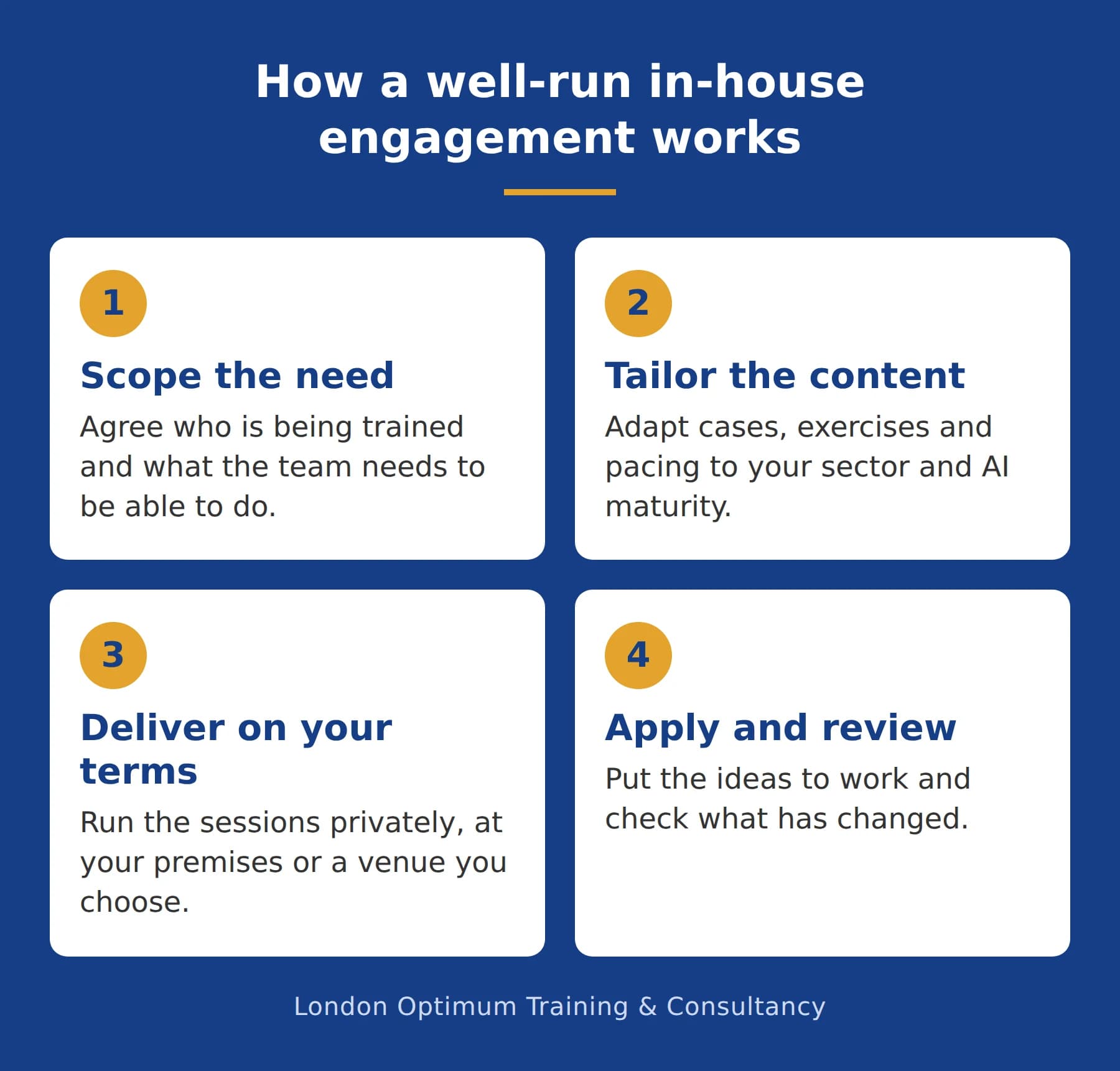
Preparation is the first step of a wider process. A well-run engagement typically moves through four stages: scoping the need, tailoring the content, delivering on your terms, and applying and reviewing what was learned.
Why Instructor-Led Delivery Matters for Both Formats
Format matters whether training is public or in-house. Much of the value in AI training comes from live discussion and real-time application, not from content delivery alone.
That is why many organisations favour instructor-led sessions over self-paced study when the goal is for a team to change how it works, not only to understand a topic.
This applies to our public courses just as much as to in-house programmes: both are delivered in person by instructors with direct industry experience. What in-house delivery adds is the ability to apply that same instructor-led approach directly to your organisation's own context.
In-House AI Training at London Optimum (LOTC)
At London Optimum Training & Consultancy (LOTC), in-house AI training in London is built around exactly this approach: genuinely adapted content, delivered in person by instructors with direct industry experience, at your premises or a venue of your choosing.
Relevant starting points for in-house programmes include:
Frequently Asked Questions About In-House AI Training
1- What is in-house AI training?
In-house AI training is a private programme delivered for your own team by an external provider, rather than a place on a public course. It is built around your sector, tools and challenges, and can take place at your premises or a venue you choose.
2- How much does in-house AI training cost?
It depends on group size, course depth and how much customisation is involved. In-house programmes are often priced per session rather than per person, so for a full team they can be more cost-effective than booking several places on a public course. For typical UK price ranges, see our guide to how much AI courses cost in the UK.
3- How many people are needed to justify in-house training?
There is no fixed threshold, but in-house delivery tends to make the most sense once you are training a full team or department rather than one or two individuals.
4- Can in-house training still cover advanced or technical AI topics?
Yes. The in-house format does not limit depth. If anything, it allows more advanced or sensitive material to be covered than would be appropriate in a mixed public session.
5- Does in-house training happen at our office, or at a separate venue?
Both are usually possible. Many organisations prefer their own premises for convenience, while others choose a neutral venue to minimise workplace interruptions.
6- How far in advance should we plan an in-house AI training programme?
Allow enough lead time for genuine customisation: understanding your sector, current AI maturity and specific challenges. Booking at the last minute usually limits how much tailoring is possible.