What Is Project Management? A Practical Guide for Businesses
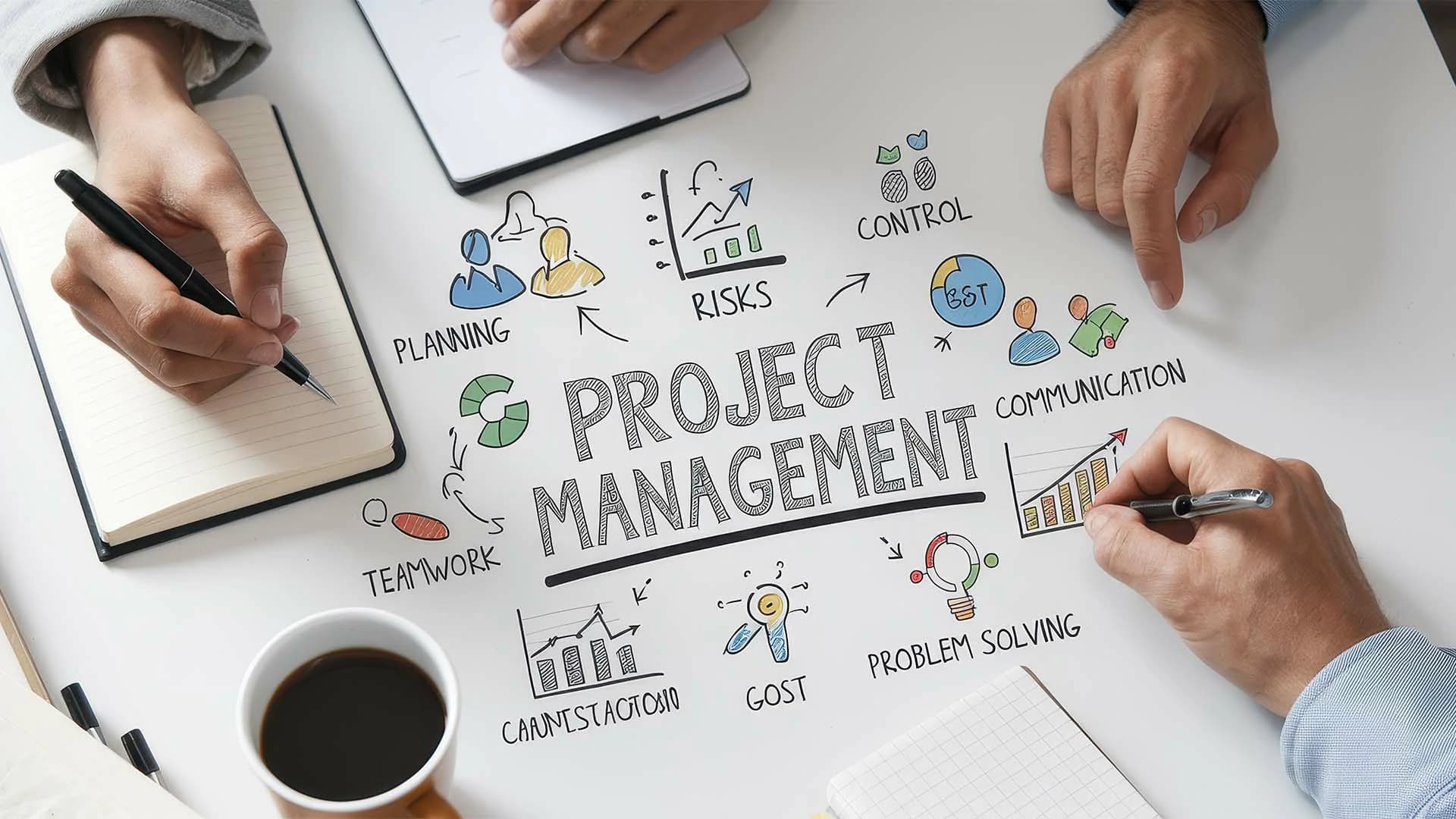
What is project management? It is the coordinated application of knowledge, skills, tools and techniques to turn a defined objective into a completed project within agreed constraints. In practice, it means making clear decisions about value, scope, time, cost, quality, risk, people and change from the initial idea through to handover.
Project management is not simply creating a task list or updating software. It gives temporary, often cross-functional work a clear purpose, accountable leadership, an achievable plan and a controlled way to respond when reality differs from expectations.
This guide explains the project management definition, lifecycle, roles, approaches, tools and business value and shows how they work together in a real project.
Project Management Definition
The Project Management Institute defines project management around applying knowledge, skills, tools and techniques to project activities in order to meet requirements. The UK's Association for Project Management similarly emphasises achieving specific objectives and acceptance criteria within agreed parameters, including a finite timescale and budget.
A useful business definition is:
Project management is the structured coordination of temporary work to deliver an agreed output or change, while managing decisions, constraints, uncertainty and stakeholder expectations.
This definition matters because project management is broader than scheduling. A project may finish on its planned date yet still fail if the output is unusable, the business is not ready to adopt it or the expected value cannot be realised.

What Makes Work a Project?
A project is temporary and produces a defined, non-routine output, service or result. Business-as-usual operations sustain repeatable work, while projects create or enable change.
Examples include opening a service centre, implementing an enterprise system, developing a new product, relocating an office, delivering a regulatory change or constructing a facility. Processing monthly payroll, operating a help desk or running routine production is normally operational work, although a project may be created to redesign any of those activities.
What Does Project Management Involve?
Project management integrates several areas that cannot be controlled independently.
These areas interact. Adding scope may require more time and funding; shortening a schedule may increase cost or delivery risk; a technically complete output may need further training, data or process change before users can adopt it. The project manager's job is to make these dependencies visible and support informed trade-offs.
The Project Management Lifecycle
A project lifecycle provides the high-level stages that take work from an idea to an operational result. Names vary between organisations, but the following model explains the core project management process.
1. Concept and initiation
The organisation defines the need, expected value, possible options and initial constraints. A business case tests whether the proposed investment is justified. The sponsor, objectives, high-level scope, stakeholders and governance should become clear enough to support a decision to proceed, revise or stop.
2. Planning
The team converts the approved idea into an integrated delivery plan. It develops the scope, requirements, schedule, budget, resource plan, quality approach, risk responses, procurement needs, communication arrangements and success measures.
Planning should create a credible basis for decisions, not an illusion of certainty. LOTC's guide to the project planning process explains this stage in greater detail.
3. Delivery and execution
People complete the planned work, manage suppliers, create outputs, resolve issues and engage stakeholders. The project manager integrates activity across workstreams and ensures that decisions are made at the right level.
Execution is not blind adherence to the original plan. Teams must use current evidence, protect agreed objectives and escalate when conditions move beyond authorised tolerances.
4. Monitoring and control
Monitoring occurs throughout delivery rather than after it. The team compares actual and forecast performance with the approved plan, reviews risks and issues, tests quality and manages proposed changes.
Useful control asks forward-looking questions: What is likely to happen next? Which assumptions no longer hold? What decision is required? A status report that only describes completed activity provides little control.
5. Closure, transition and review
The project confirms acceptance, closes contracts, transfers outputs and knowledge, resolves or hands over remaining actions and records useful lessons. Operational owners need the people, processes, data, support and authority required to use the result.
Formal closure does not necessarily mean all benefits have been realised. Some benefits emerge months later, so ongoing accountability and review dates should be agreed before the temporary project team disbands.
The lifecycle is not always a single linear sequence. Adaptive projects repeat short cycles of planning, delivery and review, while hybrid projects may combine iterative development with formal stage gates and a fixed transition date. The APM describes a lifecycle as the high-level structure that transforms an idea into reality; organisations should tailor that structure to the work.
Who Is Responsible for Project Success?
Project management is a shared system of accountability, not the work of one person.
- The sponsor owns the continuing business justification, provides senior direction, secures organisational commitment and remains accountable for intended benefits.
- The project manager leads day-to-day integration, planning, delivery, control, communication and escalation.
- The governance or steering group makes defined decisions, reviews assurance and supports alignment with organisational priorities.
- The project team and specialists create the outputs, estimates and technical evidence needed for delivery.
- Business owners and users define needs, test suitability, prepare for adoption and operate the result after handover.
- Suppliers and partners deliver contracted outputs and provide information needed to manage dependencies, quality and risk.
Accountability should be explicit. If nobody owns the business case, accepts the output or makes priority decisions, adding more project documentation will not solve the problem.
For a British public-sector reference, the UK Government Functional Standard GovS 002 sets expectations for the direction and management of portfolios, programmes and projects, providing a consistent basis for governance, assurance, risk management and capability improvement.
What Are the Main Types of Project Management?
“Types of project management” commonly refers to delivery approaches. Current professional guidance recognises a spectrum rather than one universal method.
Scrum is a framework, Kanban is a flow strategy, Lean is a management philosophy and the Critical Path Method is a scheduling technique. They should not be presented as equivalent project types. LOTC's comparison of project management frameworks and approaches explains when each is useful and how they can work together.
ISO 21502:2020 confirms that project-management guidance can apply across different organisations, project types, delivery approaches, lifecycle models, sizes and levels of complexity. The approach should therefore be tailored to the project, not selected by habit.
Project Management Tools and Techniques
The word “tool” may refer to a management document, an analytical technique or a software platform. Each should support a decision or behaviour.
Software can centralise these artefacts, automate updates and improve collaboration. It cannot decide whether the business case is still valid, whether an estimate is credible or which trade-off best protects value. Choose software after defining the workflow, governance, information needs and user capability.
Project Management Example: Opening a New Service Centre
Consider an organisation opening a regional customer service centre.
Initiation: The sponsor defines the objective, such as increasing service capacity and reducing response times. The business case compares location and operating options, expected costs, risks and benefits.
Planning: The project team integrates property, facilities, technology, recruitment, training, suppliers, compliance and launch communications. A schedule exposes dependencies for example, systems testing may depend on network installation, while employee training depends on access to a working environment.
Delivery: Workstreams complete fit-out, system configuration, hiring, process design and readiness activities. The project manager coordinates decisions and manages interfaces rather than performing every specialist task.
Control: Dashboards show milestones, expenditure, readiness and key risks. If a supplier delay threatens the launch, the team evaluates options and impact before an authorised decision changes the plan.
Transition and review: The operational manager accepts the site, systems, staff and procedures. Remaining actions transfer to named owners. After launch, the organisation reviews response time, service quality and capacity to determine whether the intended benefits are emerging.
The example shows why task tracking alone is insufficient: success depends on business justification, integrated planning, governance, adoption and operational results.
Why Project Management Matters to Businesses
Good project management does not guarantee success, but it creates conditions for better decisions.
- Strategic alignment: projects remain connected to a justified need and expected value.
- Clear accountability: sponsors, managers, teams and business owners understand their decisions and responsibilities.
- Integrated visibility: leaders can see the combined effects of scope, time, cost, quality, resources and risk.
- Earlier intervention: reliable forecasts and escalation reveal problems while useful options still exist.
- Controlled change: requests are evaluated rather than implemented informally.
- Stakeholder confidence: information is tailored to decisions instead of reporting activity for its own sake.
- Stronger transition: users and operational teams are prepared to adopt and sustain the output.
The answer is not maximum governance. Small, low-risk projects need proportionate controls; complex or high-risk investments need stronger assurance and decision discipline. Effective project management is rigorous enough to protect the work and light enough to help it move.
Signs a Business Needs More Structure
An organisation may need to strengthen project management when:
- initiatives begin without a clear sponsor, business case or success criteria;
- status depends on opinion because plans and data are unreliable;
- scope changes through conversations without impact assessment;
- risks are discussed repeatedly but have no owner or response;
- teams discover dependencies only when delivery is already delayed;
- projects compete for the same people without portfolio-level priorities;
- “completion” means the supplier finished, even though the business is not ready;
- lessons are recorded but do not influence future work.
Begin by fixing decision rights, minimum information and the few controls that address the greatest delivery risks. Adding every template at once usually creates compliance activity without better management.
Common Project Management Mistakes
- managing tasks without maintaining the business objective;
- expecting the project manager to compensate for an absent sponsor;
- treating the first plan as a promise rather than a decision baseline;
- selecting a methodology before understanding uncertainty and constraints;
- implementing changes before approval;
- reporting historical activity without forecasting outcomes;
- assuming software will create ownership or reliable data;
- measuring success only by time and cost while ignoring quality, adoption and value;
- closing the project before operational readiness and benefit accountability are clear.
Build Practical Project Management Capability with LOTC
LOTC's Project Management Fundamentals course introduces the lifecycle, scope, planning, risk, communication, monitoring, change and closure. Professionals and teams seeking broader coverage can explore the Comprehensive Guide to Project Management or LOTC's full range of project management courses.
Choose training according to the decisions participants make, their current experience and the delivery problems the organisation needs to solve. To discuss an individual or corporate requirement, contact LOTC on WhatsApp.
FAQs
What is project management in simple terms?
Project management is the structured coordination of temporary work to achieve a defined objective. It brings together people, plans, resources, risks, decisions and stakeholders so an agreed output can be delivered and moved into use.
What are the five stages of project management?
A common high-level lifecycle includes concept and initiation, planning, delivery, monitoring and control, and closure and transition. Monitoring takes place throughout delivery, and adaptive projects may repeat planning and delivery in shorter cycles.
What are the three main project management approaches?
The main approaches are predictive, adaptive or Agile, and hybrid. Predictive delivery suits relatively stable work, adaptive delivery supports learning and change, and hybrid delivery combines elements according to the project's context.
What is the difference between project management and programme management?
Project management coordinates a temporary project to deliver defined outputs and objectives. Programme management coordinates related projects and business change to achieve combined outcomes and benefits that require broader, longer-term oversight.
What skills does a project manager need?
Project managers need integrated planning and control, risk and commercial awareness, communication, leadership, negotiation, problem-solving, data interpretation and situational judgement. LOTC's guide to project management career opportunities explains how these capabilities support different career paths.