
Business Impact Analysis: Steps, Recovery Priorities and Worked Example
Business impact analysis (BIA) begins with a question every organisation should be prepared to answer: when several critical operations stop simultaneously, which should be restored first?
The answer is not always the process generating the most revenue. A less visible activity may support several essential services, while even a short interruption elsewhere could trigger contractual breaches, financial losses or operational failures.
An effective business impact analysis helps organisations move beyond assumptions by assessing disruption over time, identifying critical dependencies and establishing defensible recovery priorities.
This guide explains how to conduct a BIA, determine recovery time and recovery point objectives (RTO and RPO), and translate the findings into practical recovery decisions through a worked example.
What Is a Business Impact Analysis, and What Decisions Does It Support?
A business impact analysis (BIA) is a structured assessment of the consequences of disrupting business activities and how those consequences develop over time. It establishes how long an organisation can tolerate an interruption before its effects become unacceptable.
An effective business impact assessment supports three essential management decisions:
- Recovery priorities: Determine which activities must resume first to protect essential products, services and business commitments.
- Recovery requirements: Establish acceptable interruption limits and the minimum operational capacity needed during recovery.
- Resource allocation: Identify the people, technology, facilities, suppliers and dependencies required to restore prioritised activities.
Unlike a risk assessment, which examines potential threats, their likelihood and consequences, a BIA focuses on the consequences of disruption regardless of its cause.
ISO/TS 22317:2021 provides guidance for establishing a documented BIA process tailored to organisational needs.
Rather than replacing risk assessment or business continuity planning, BIA provides the recovery requirements that inform continuity strategies and resource decisions.
How to Conduct a Business Impact Analysis in Five Practical Steps
Follow a structured business impact analysis process that turns operational knowledge into evidence-based recovery decisions. Each step should produce findings that management can validate and use.
Step 1 — Define the Scope and Impact Criteria
Identify essential products, services and supporting activities. Assign process owners and establish who will approve the findings. Agree on criteria for evaluating financial, operational, regulatory, customer and reputational impacts to ensure consistent assessments across departments.
Step 2 — Collect Evidence from Process Owners
Gather information through interviews, operational records and discussions with finance, IT, human resources and relevant suppliers. Challenge unsupported assumptions about process criticality using transaction volumes, contractual obligations, historical incidents and operational dependencies.
Business Impact Analysis Questionnaire: Questions Worth Asking
Use these six questions to uncover information that directly influences recovery decisions:
- What does this process deliver, and who depends on it?
- What happens after 4, 12, 24 and 72 hours of disruption?
- Which losses are permanent, and which activities can be recovered later?
- Which people, systems, data and suppliers are essential?
- Is a manual workaround available, and how long can it remain effective?
- What minimum service level must be restored, and by when?
Step 3 — Assess How Impact Escalates Over Time
Evaluate disruption against agreed criteria at relevant time intervals. Record when consequences become unacceptable and support impact ratings with measurable evidence wherever possible. Avoid assigning a high-impact rating without explaining its operational significance.
Step 4 — Identify Dependencies and Workable Alternatives
Map shared systems, resources and upstream activities. Establish the capacity and limitations of alternative arrangements. A prioritised activity may remain unavailable if a less visible supporting service has not been restored.
Where recovery depends on external suppliers, integrate supply chain risk management to identify vulnerabilities beyond the organisation's direct control.
Step 5 — Validate Findings and Obtain Approval
Review assumptions, impact estimates and proposed priorities with relevant stakeholders. Resolve conflicting assessments, document uncertainties and obtain management approval.
A reliable business impact analysis methodology should produce more than completed questionnaires. Its outcome is a documented, validated set of operational requirements that establishes a defensible basis for recovery planning.
Measure Business Disruption Over Time, Not with a Single Score
An effective business impact assessment examines both the nature of disruption and how its consequences develop over time. Labelling an activity as high-impact tells management little about when intervention becomes necessary or how urgently recovery resources should be deployed.
Assess disruption across the following dimensions:
Financial
Irrecoverable profit margin, additional costs and cash-flow disruption
Operational
Accumulating backlogs, halted production and reduced service capacity
Customer and Contractual
Missed delivery commitments, service-level breaches and customer dissatisfaction
Regulatory and Legal
Missed statutory deadlines, reporting obligations and compliance consequences
Safety and Reputation
Harm to people, loss of stakeholder trust and prolonged service failures
A reliable assessment distinguishes between recoverable disruption and permanent damage.
Delayed revenue, for instance, does not necessarily represent lost revenue. Similarly, reputational damage should not be assigned an arbitrary financial value simply to make the assessment quantitative.
An interruption may remain manageable after four hours but become unacceptable after 24 hours as contractual deadlines pass, backlogs accumulate and temporary workarounds reach their limits.
Throughout the business impact analysis process, support impact estimates with operational evidence, documented assumptions and agreed acceptance criteria.
The objective is not to assign the highest severity rating, but to establish when the consequences of continued disruption become unacceptable to the organisation.
MTPD, RTO and RPO: How to Set Recovery Objectives from BIA Findings
Translate business impact analysis findings into recovery objectives that reflect operational priorities and the organisation’s ability to tolerate disruption. Three measures guide this decision:
MTPD — Maximum Tolerable Period of Disruption
How long can disruption continue before its consequences become unacceptable?
RTO — Recovery Time Objective
By when must a prioritised activity resume at its agreed minimum acceptable capacity?
RPO — Recovery Point Objective
How much data loss, measured in time, can the organisation tolerate?
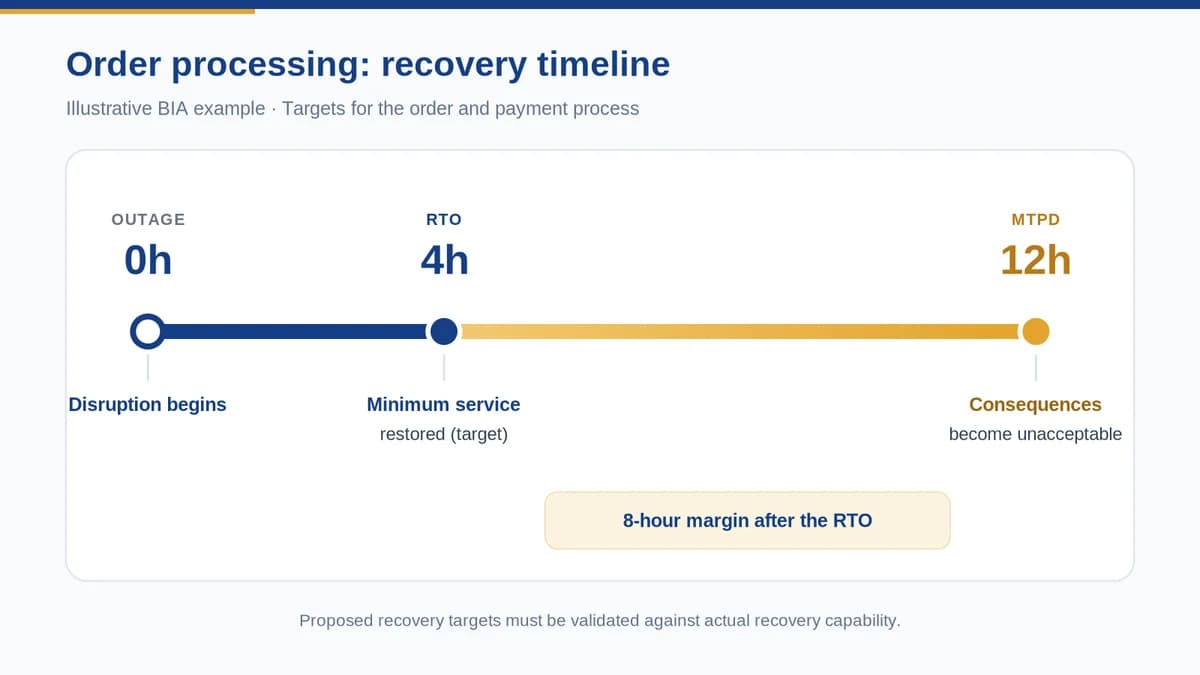
The RTO should be shorter than the MTPD, allowing sufficient time to stabilise operations, address accumulated work and prevent consequences from reaching unacceptable levels. Recovery does not necessarily mean returning to full operational capacity immediately. Restoring an agreed minimum service level may be sufficient during the initial recovery period.
The recovery point objective, by contrast, concerns data rather than operational downtime. If an organisation cannot tolerate losing more than 30 minutes of order records, its RPO should be 30 minutes or less. This requirement is independent of how long restoring the ordering system takes.
ISO/TS 22317:2021 provides guidance on establishing recovery requirements for prioritised activities, while NIST SP 800-34 Rev. 1 offers complementary guidance for information system recovery planning.
However, setting recovery objectives does not establish recovery capability. Validate proposed targets with recovery teams, considering available resources, technical limitations and operational dependencies. Where existing capabilities cannot meet business requirements, document the gap and determine what improvements or investments are necessary before disruption occurs.
Business Impact Analysis Example: Setting Defensible Recovery Priorities
Consider a business impact analysis example involving a trading and distribution company experiencing a widespread systems outage. Management must establish recovery priorities for order and payment processing, warehouse dispatch and routine management reporting.
The following figures, operational assumptions and acceptance thresholds are hypothetical.
Compare Disruption Impacts and Set Recovery Targets
Assume the company normally processes 100 orders per hour. During an outage, 20% of potential orders are permanently lost, with an average contribution margin of SAR 50 per lost order. This represents an estimated loss of SAR 1,000 per hour.
Meanwhile, the warehouse has existing shipment commitments equivalent to 50 orders per hour.
Management establishes the following targets based on agreed impact thresholds:
The company considers SAR 12,000 in lost contribution unacceptable. A four-hour recovery time objective therefore provides an eight-hour margin before reaching this threshold.
For warehouse dispatch, an eight-hour RTO leaves time to address 400 delayed orders before delivery deadlines, subject to available processing capacity. Reporting receives a longer recovery window to accommodate preparation and review before its deadline.
A 30-minute recovery point objective is proposed for order records because staff can reliably reconcile up to 30 minutes of transactions using independent payment records.
Resolve Dependencies Before Approving Recovery Order
Order processing requires payment gateways, identity services and transaction databases. Warehouse dispatch depends on accessible inventory records and functioning warehouse management systems.
Before approving recovery priorities, management must:
- Establish the restoration sequence for shared dependencies.
- Define minimum service levels for essential orders and time-critical shipments.
- Verify that recovery resources and system capabilities can meet the proposed targets.
The resulting business impact analysis report documents the evidence behind each priority, approved recovery requirements and capability gaps requiring investment or testing.
Business Impact Analysis Template and Final Review Checklist
Use the following business impact analysis template to document assessment findings consistently across departments. Complete one record for each activity, ensuring that proposed recovery requirements are supported by evidence and reviewed by the relevant stakeholders.
Process and Owner
Business activity and accountable process owner
Disruption Impact
Consequences at agreed time intervals
MTPD, RTO and RPO
Proposed or approved recovery requirements
Dependencies
Essential people, systems, data, facilities and suppliers
Minimum Service Level
Acceptable operational capacity during recovery
Evidence and Assumptions
Supporting information and justification for recovery priorities
Decisions and Actions
Approval status, capability gaps, responsible individuals and next steps
Before finalising your findings, use this business impact analysis checklist:
- Are disruption impacts documented over time and supported by credible evidence?
- Have process owners' estimates been independently challenged and validated?
- Are critical dependencies, alternative arrangements and their limitations clearly identified?
- Have recovery teams assessed the feasibility of proposed recovery objectives?
- Are the findings formally approved, with assigned responsibilities and defined review triggers?
While the template provides a structured method for collecting and documenting information, the business impact analysis report should consolidate recovery priorities, approved requirements, unresolved capability gaps and decisions requiring management action.
The analysis delivers value when its findings inform continuity plans, resource allocation and recovery exercises, rather than remaining an approved document that has never been tested against operational reality.
Turn Business Impact Analysis into Stronger Continuity Capability with LOTC
The value of business impact analysis lies not in how many activities an organisation classifies as critical, but in how confidently its people can decide what must recover, when and with which resources.
Developing that capability requires shared expertise across operations, risk management, IT and leadership.
At London Optimum Training & Consultancy (LOTC), our Business Continuity and Crisis Management course covers business impact analysis, risk assessment, critical dependencies, recovery objectives, and the development and testing of continuity plans.
Build the expertise to turn recovery requirements into coordinated action before disruption puts your decisions to the test. Contact LOTC on WhatsApp to discuss the training needs of your organisation.