
Risk Appetite Statement: How to Write One, Examples & Template
A risk appetite statement defines which risks an organisation is prepared to take in pursuit of its strategic objectives and where it must draw the line.
A business may willingly accept controlled financial losses when entering a new market, yet refuse to expose its essential services to significant disruption. The challenge is not whether to take risks, but which risks to accept, how much exposure to tolerate and when to intervene.
This guide explains how to write a risk appetite statement, distinguish risk appetite from tolerance and capacity, and translate strategic intentions into measurable limits through practical examples and a reusable template.
What Is a Risk Appetite Statement, and What Should It Actually Decide?
A risk appetite statement is a formal expression of the types and extent of risk an organisation is willing to accept in pursuit of its strategic objectives. It translates leadership's intentions into a common basis for evaluating opportunities, allocating resources and making decisions involving uncertainty.
An effective statement should answer three fundamental questions:
- Risk-taking: Which risks are we prepared to take to achieve our objectives?
- Acceptable exposure: Where are the boundaries of acceptable risk?
- Decision-making authority: Who decides when exposure exceeds those boundaries?
As the Institute of Risk Management explains, risk appetite varies according to organisational objectives, culture and risk categories. A business may actively pursue innovation while maintaining a cautious approach to service disruption and rejecting deliberate regulatory violations.
The statement forms an integral part of enterprise risk management. Rather than replacing risk assessments or risk registers, it establishes the criteria against which identified risks are evaluated throughout the risk management process.
Risk Appetite vs Risk Tolerance vs Risk Capacity: The Difference
Understanding the distinction between risk appetite and risk tolerance is essential to establishing boundaries that reflect strategic intentions without exceeding the organisation's capacity to absorb adverse consequences.
Risk Appetite
What types and levels of risk are we willing to accept to achieve our objectives?
Risk Tolerance
What variation or exposure limits are acceptable for a particular risk or objective?
Risk Capacity
What level of risk can we withstand without compromising organisational viability or essential obligations?
Risk appetite establishes the strategic direction, tolerance defines operational boundaries, and capacity represents the organisation's underlying ability to absorb adverse outcomes.
Consider a hypothetical company pursuing market expansion. Financial analysis indicates that it could withstand aggregate losses of SAR 2 million. However, its board adopts a cautious risk appetite, authorising exposure of no more than SAR 200,000 across experimental ventures, with an individual pilot loss limit of SAR 50,000.
SAR 2 million
Capacity
SAR 200,000
Appetite
SAR 50,000
Pilot limit
Exceeding that individual limit would require escalation, even if the organisation remained within its overall financial capacity.
The ability to withstand a loss does not constitute permission to accept it.
Although terminology varies across professional frameworks, guidance from the Australian Department of Finance illustrates how specific tolerance boundaries translate strategic appetite into practical decisions. Establishing this distinction provides the foundation for drafting an actionable statement.
How to Write a Risk Appetite Statement in Five Practical Steps
Build a risk appetite statement around the decisions your organisation needs to make, rather than a generic classification of acceptable risks. The following five steps adapt principles from the United Nations' 2025 Guidelines on Risk Appetite Statements into a practical approach for business leaders.
Step 1 — Start with Strategic Objectives and Material Risks
Identify the objectives the organisation seeks to achieve, whether market expansion, service reliability or regulatory compliance. Review the risk register and operating environment to identify uncertainties that could materially affect these objectives.
Expected outcome: A focused set of strategic objectives and relevant risk categories.
Step 2 — Review Existing Exposure and Risk Capacity
Examine current risk exposure, historical losses, control effectiveness and available financial and operational resources. Distinguish between risks deliberately taken to pursue opportunities and those arising from existing operations.
Expected outcome: An evidence-based understanding of current exposure and the organisation's capacity to absorb adverse outcomes.
Step 3 — Agree Appetite Levels with Leadership
Engage the governing body and executive management in determining acceptable levels of risk-taking. Define what each appetite level means in practice, including which decisions managers may authorise and which require further approval.
Expected outcome: An agreed strategic position for each material risk category.
Step 4 — Draft Clear Statements and Define Measurable Boundaries
Connect each appetite statement to a strategic objective, supported by appropriate risk appetite limits, measurable indicators and accountable risk owners. Use qualitative boundaries where numerical thresholds would create misleading precision.
Expected outcome: A draft statement with clearly defined operational boundaries.
Step 5 — Validate, Approve and Communicate
Test the proposed boundaries against realistic scenarios with finance, compliance, operations and risk owners. Obtain formal approval, establish escalation responsibilities and communicate the requirements to relevant decision-makers.
Expected outcome: An approved, actionable statement understood by those responsible for implementing it.
An effective risk appetite framework connects strategic intentions with everyday decisions, giving managers the authority to pursue opportunities while recognising when further approval or intervention is necessary.
Risk Appetite Statement Example: From Strategy to Measurable Limits
Consider a medium-sized trading and distribution company expanding its digital sales. Management wants to encourage innovation without compromising essential services or regulatory compliance.
This risk appetite statement example demonstrates how strategic intentions become measurable boundaries that guide everyday decisions.
All figures and thresholds are hypothetical and do not represent regulatory requirements or industry benchmarks.
A Practical Risk Appetite Statement Example Across Three Risk Areas
The company adopts the following statement:
We accept measured risks in digital innovation within approved financial limits, while maintaining a low appetite for essential service disruption and no appetite for deliberate regulatory breaches.
The following risk appetite matrix translates these commitments into operational boundaries:
Digital innovation
ModerateTotal approved potential loss across digital pilots must not exceed SAR 200,000 during the financial year, with no individual pilot exceeding SAR 50,000.
Critical service reliability
LowUnplanned ordering-service downtime must not exceed 60 minutes per calendar month
Regulatory compliance
No appetite for deliberate violationsAny confirmed intentional breach requires immediate escalation and corrective action
Unlike a traditional risk assessment heat map, this matrix defines acceptable risk-taking and decision boundaries, rather than estimating likelihood and impact.
Importantly, rejecting deliberate regulatory breaches does not mean all compliance risks can be eliminated.
Worked Example: Turning a Low Risk Appetite into a Tolerance Limit
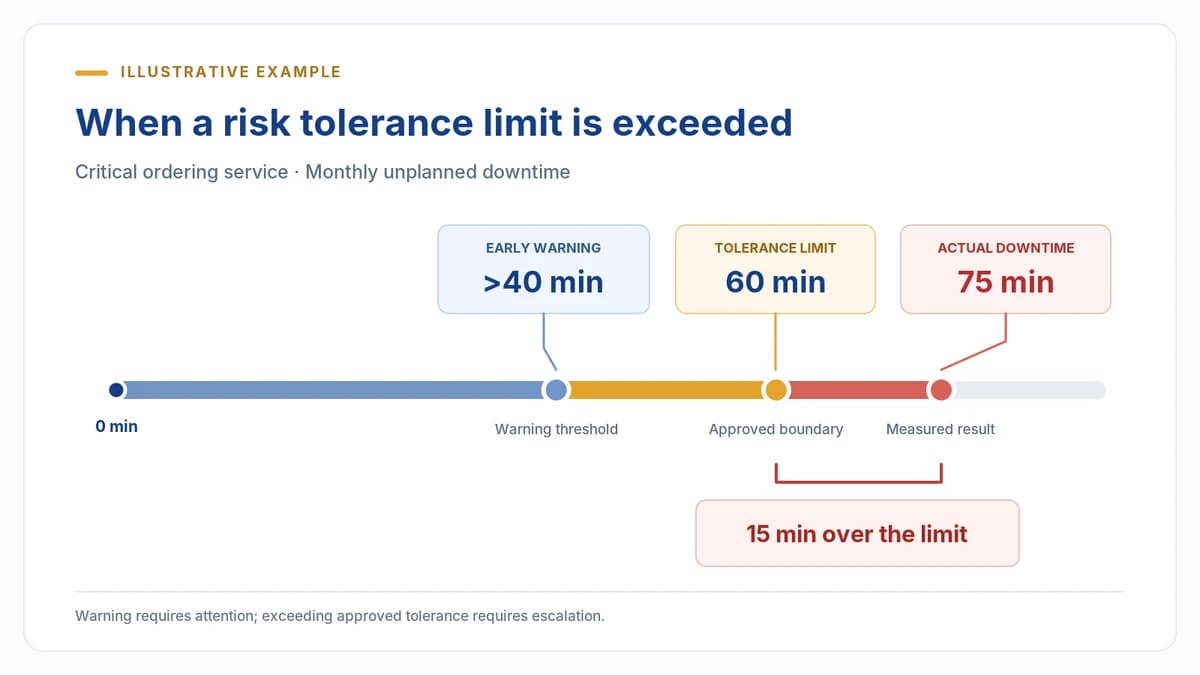
Consider the company's critical ordering service. Management establishes the following monitoring requirements:
- Risk appetite: Low for critical service disruption.
- Key Risk Indicator (KRI): Cumulative unplanned downtime per calendar month.
- Early-warning trigger: More than 40 minutes.
- Approved tolerance limit: 60 minutes.
- Current measured downtime: 75 minutes.
The service has exceeded its approved tolerance limit by 15 minutes. The breach requires a defined management response, not simply a higher risk rating.
The accountable manager must:
- Record the breach: Document its causes, duration and customer impact.
- Escalate appropriately: Notify the designated risk owner and authorised decision-makers.
- Implement corrective action: Assign measures, resources, responsibilities and deadlines.
- Monitor effectiveness: Prevent further disruption and assess performance against the limit in subsequent reporting periods.
Because cumulative monthly downtime cannot be reversed, corrective action cannot erase the recorded breach. Any exception must follow established approval procedures.
As explained by GARP's 2025 analysis of enterprise risk management and risk appetite, connecting appetite statements to KRIs, thresholds and defined responses makes risk governance actionable.
The real value of a risk appetite statement is knowing exactly when management must intervene and who is responsible for the decision.
Risk Appetite Metrics: How to Monitor Limits and Escalate Breaches
Risk appetite metrics turn an approved statement into a working control system. For each material risk, establish a key risk indicator (KRI) that shows when exposure approaches or exceeds agreed risk appetite limits.
Each monitoring record should specify:
- Definition: What is measured and how it is calculated.
- Data source: Where reliable evidence is obtained.
- Monitoring frequency: How often results are reviewed.
- Warning threshold: When preventive action becomes necessary.
- Breach threshold: When exposure exceeds approved tolerance.
- Risk owner: Who investigates, responds and escalates, and who can authorise exceptions.
Use both leading indicators, such as overdue control actions or unresolved supplier dependencies, and lagging indicators, such as actual downtime or financial losses.
Not every performance KPI is a useful KRI. Similarly, crossing an early-warning threshold requires attention but does not automatically constitute a tolerance breach.
An effective risk appetite framework establishes how breaches are documented, escalated and resolved. Repeated breaches should trigger scrutiny of controls, resources and management decisions, rather than automatic relaxation of limits.
Review the statement when strategic objectives change, new markets are entered, material risks emerge, risk capacity shifts or breaches recur.
The United Nations' 2025 Guidelines on Risk Appetite Statements provide guidance on operationalising risk appetite through monitoring, escalation and periodic review.
Risk Appetite Statement Template and Board Review Checklist
Use this risk appetite statement template to translate strategic risk decisions into a document managers can apply and governing bodies can scrutinise. Complete the following fields for each material risk category, adapting them to your organisation's objectives and governance arrangements.
To illustrate how this template works in practice, the following completed example uses the critical ordering service from the scenario above. All thresholds and responsibilities are illustrative and should be adapted to the organisation's operating context.
Before approving the statement, the board or relevant governing body should ask:
- Strategic alignment: Does each statement support a defined organisational objective?
- Decision clarity: Can managers distinguish acceptable from unacceptable exposure?
- Practical limits: Are measures and thresholds credible, achievable and supported by evidence?
- Accountability: Are ownership, escalation routes and exception authorities clearly assigned?
- Implementation: Has the statement been approved, communicated and assigned appropriate review triggers?
A strong risk appetite framework combines measurable thresholds where reliable evidence exists with qualitative boundaries where numerical precision would be misleading.
This risk appetite statement sample provides a starting structure, not a universal policy. Its value depends on whether managers can use it to make consistent, defensible decisions and respond appropriately when risk exposure exceeds agreed boundaries.
Strengthen Governance and Risk Appetite Decision-Making with LOTC
A risk appetite statement creates value when it guides real decisions, not simply when it receives formal approval. Without agreed boundaries, managers may interpret the same exposure differently, accept risks beyond the organisation's intentions or delay necessary intervention.
At London Optimum Training & Consultancy (LOTC), our Governance, Risk and Compliance (GRC) Strategy course helps professionals connect risk appetite and tolerance with governance responsibilities, risk assessment, compliance monitoring and integrated GRC frameworks.
The goal is to equip leaders and teams to turn strategic risk decisions into clear accountability, consistent judgement and timely action when agreed limits are exceeded.
Make risk governance a practical part of how your organisation operates. Contact LOTC on WhatsApp to discuss training tailored to your team's priorities.
FAQs about Risk Appetite Statement
Who Is Responsible for Approving a Risk Appetite Statement?
The board or relevant governing body should approve the organisation's risk appetite statement, supported by executive management and risk specialists. Operational managers then apply the approved boundaries within their responsibilities. Clear ownership, reporting arrangements and escalation authority help ensure that risk-taking remains consistent with strategic objectives.
What Is the Difference Between Risk Appetite and Risk Tolerance?
Risk appetite defines the types and levels of risk an organisation is willing to accept to achieve its objectives. Risk tolerance establishes specific boundaries for that exposure. For example, a company may have a low appetite for service disruption and set a maximum tolerance of 60 minutes of unplanned downtime per month.
Can an Organisation Have Zero Risk Appetite?
An organisation can adopt no appetite for specific behaviours, such as deliberate regulatory violations. However, this does not mean that all associated risks can be eliminated. The statement should distinguish unacceptable conduct from residual exposure and establish appropriate controls, monitoring requirements and escalation procedures.