How to Write an Internal Audit Report: Format, Example & Template
An internal audit report can identify a serious control weakness and still fail to prompt action. The evidence may be sound, but if managers cannot see what went wrong, why it matters or who should respond, the risk remains.
Effective reporting turns audit evidence into clear findings, well-supported conclusions and practical recommendations. It helps decision-makers understand control weaknesses, prioritise risks and assign responsibility for corrective action without overstating what the audit has established.
This guide explains how to structure and write an internal audit report, develop evidence-based findings and communicate recommendations effectively. You will also find a worked example and a reusable template to apply in your next audit.
What Is an Internal Audit Report?
An internal audit report is a written communication of an audit engagement’s objectives, scope, findings and conclusions, supported by the evidence gathered during the review.
For assurance engagements, it explains which activities or controls were examined, identifies significant findings and their risks, and outlines recommendations or agreed action plans. It should also make clear who is responsible for addressing findings and when actions are expected to be completed.
This gives management and, where appropriate, the audit committee a reliable basis for prioritising improvements and monitoring progress. The Institute of Internal Auditors’ Standard 15.1 sets requirements for final engagement communications.
Effective internal audit report writing is therefore not about listing faults. It is about communicating defensible conclusions and practical next steps—not expressing an external auditor’s opinion on the financial statements.
Internal Audit Report Format: What Should It Include?
Choose an internal audit report format that suits the engagement and its intended readers. Although layouts vary, the report must communicate its objectives, scope, conclusions and applicable recommendations or action plans. Assurance engagements also require findings, their significance and any scope limitations to be addressed.
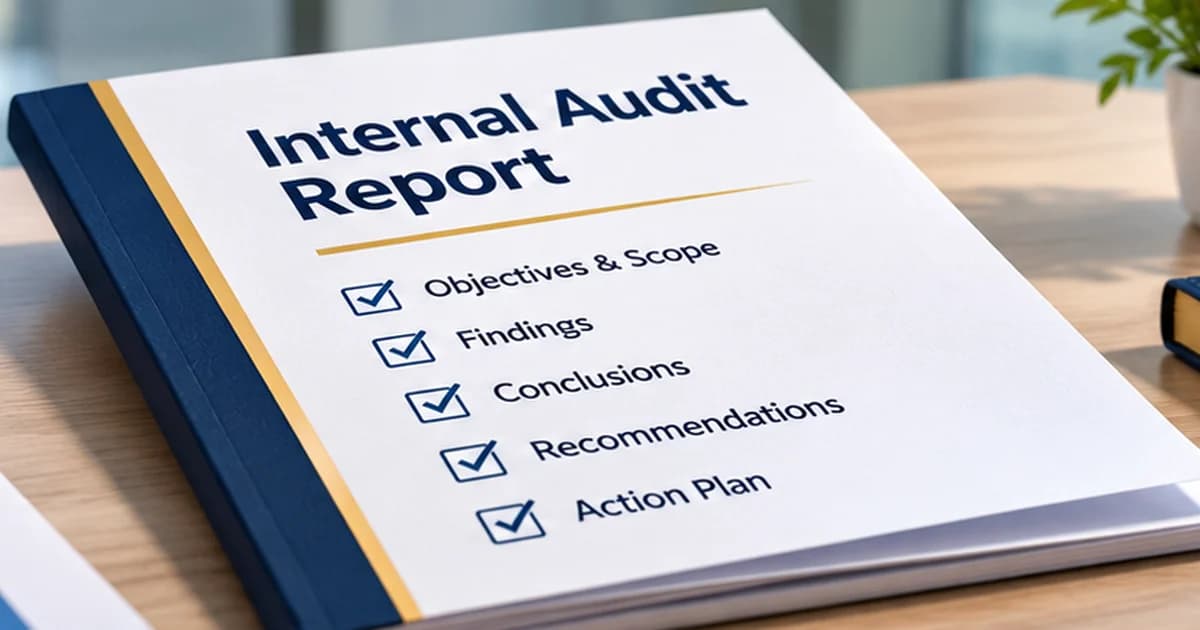
A practical internal audit report structure includes:
Identify the engagement, audited area and reporting date.
Highlight the overall conclusion and priority findings.
Explain what was examined and the boundaries of the review.
Present evidence-based issues and their relative importance.
Assess the relevant governance, risk management and control processes.
Explain how identified weaknesses will be addressed.
Record management's position and agreed actions, where applicable.
Identify responsible individuals and planned completion dates.
The Institute of Internal Auditors’ Standard 15.1 establishes reporting requirements, not a fixed template. An executive summary is useful but not a mandatory heading. Assurance reports must disclose scope limitations, while actions already initiated or completed by management must be acknowledged.
Senior management and audit committees may prefer concise summaries of significant risks, while operational managers need sufficient detail to implement corrective actions. Adapt the presentation without weakening the evidence or conclusions.
How to Write an Internal Audit Report Step by Step
Build an internal audit report from verified evidence towards decisions managers can act on. Follow these five steps to keep findings accurate and recommendations useful.
1. Confirm the Audit Objective, Scope and Evidence
Recheck what the engagement was designed to assess, which activities were tested and any limitations. Ensure evidence is relevant, reliable and sufficient to support each finding. A sample identifies what was observed; it does not automatically prove that the same weakness exists across every transaction.
2. Identify and Prioritise Significant Findings
Separate the observed control failure from its potential consequences. Assess likelihood, impact and significance using the organisation’s risk methodology. Do not label an issue “high risk” simply because a procedure was breached.
3. Draft the Executive Summary and Conclusions
Write an internal audit executive summary that states the purpose, overall conclusion and findings requiring management attention. Explain what the results mean for the audited activity, rather than repeating every observation or filling the opening with background information.
4. Agree Recommendations and Management Actions
Discuss factual accuracy, root causes and feasible remedies with responsible managers. Record proposed actions, accountable owners and target dates. Where management disagrees, document the differing positions without compromising the auditor’s independent judgement.
5. Review, Approve and Issue the Report
Check that conclusions match the evidence, risk descriptions are proportionate and wording is clear and objective. Under the IIA’s Global Internal Audit Standards, the chief audit executive must review and approve the final engagement communication before issuance. Distribute it to appropriate recipients in line with established procedures.
Effective internal audit report writing makes the path from evidence to accountability visible—not just the audit findings themselves.
How to Write Internal Audit Findings and Recommendations Using the 5 Cs
Write internal audit findings that connect observed weaknesses to control requirements, explain the associated risks and identify what needs to change. The 5 Cs of internal audit report writing provide a useful framework:
Criteria
What should have happened?
Condition
What was actually found?
Cause
Why did the weakness occur?
Consequence
What risk or impact does it create?
Corrective Action
What needs to change?
The Chartered Institute of Internal Auditors presents this as a communication aid, not a mandatory IIA reporting template. Some organisations use effect instead of consequence or recommendation instead of corrective action.
Compare two descriptions of an approval weakness:
Weak finding: “Approval procedures were not consistently followed.”
Stronger finding: “Sample testing identified supplier invoices above the £5,000 threshold without recorded evidence of the required second approval.”
The stronger version specifies the control requirement and what the auditor could verify. It does not assume the approvals never occurred. The following worked example supplies the sample figures and shows how to report the issue.
When developing internal audit findings and recommendations, separate a verified control weakness from its root cause. A workflow that permits invoices to proceed without a recorded approval is a demonstrable design weakness, but transaction records and discussions may still be needed to explain each exception. Root Cause Analysis can help test explanations rather than accepting assumptions.
Recommendations should address the evidenced weakness. For instance, a mandatory approval gate and periodic exception monitoring are more testable than telling staff to “be more careful”. State the expected control outcome, agree who will implement it and establish what evidence would show that it works.
Finally, describe exposure to unauthorised payments as a risk, not a proven loss. Proportionate reporting makes findings more credible and the resulting actions more useful.
Internal Audit Report Example: From Finding to Management Action
Use this fictional internal audit report example to follow one issue from audit evidence to management action. It illustrates a draft report extract; the final risk priority must be confirmed before issue.
Internal Audit Executive Summary Example
Engagement: Supplier invoice approval controls at a medium-sized distribution company.
Objective and scope: Assess whether invoices above £5,000 received the secondary approval required by company policy. Auditors examined 40 sampled invoices, related approval records and workflow configuration.
Conclusion: The secondary-approval control was not operating consistently as intended. Seven sampled invoices lacked recorded evidence of a second approval, and testing confirmed that the workflow could advance an invoice without checking for that record. This creates exposure to unauthorised payments and weakens the audit trail.
These observations do not establish that approval never occurred, that losses resulted or that the exception rate applies to all invoices. The weakness is substantiated; the precise causes of individual missing records require further investigation. Management proposes an enforced approval gate and monthly exception reviews. The formal risk priority will depend on invoice values, other controls and the organisation's rating methodology.
Audit Finding and Management Response Example
The following audit finding example separates confirmed observations from explanations requiring further investigation.
Audit Finding and Management Response Example
Finding
Missing documented secondary approvals.
Evidence
Seven of 40 invoices above £5,000 lacked recorded secondary approval.
Criteria
Company policy requires second approval before processing.
Verified Control Weakness
Workflow permits an invoice to advance without a recorded second approval.
Root Cause Status
Not fully established for each exception; investigate transaction histories and approval practices.
Risk
Increased exposure to unauthorised payments and unreliable approval records.
Risk Significance / Priority
Confirm using invoice values, likelihood, compensating controls and the organisation's risk methodology before final issue.
Recommendation
Enforce an approval gate and monitor exceptions.
Management Action
Configure system checks and review exceptions monthly.
Owner / Deadline
Accounts Payable Manager, with Finance Systems; 31 January 2027 (illustrative).
Verification
Retest system settings and sample invoices after implementation.
Illustrative management response: “We accept the finding. Finance Systems will introduce the approval gate, and Accounts Payable will review exceptions monthly. The Accounts Payable Manager will report progress against the agreed deadline.”
Management's acceptance does not demonstrate completion. Internal audit should verify both the configured control and its operation after implementation.
The example deliberately avoids inventing a high-risk rating, fraud finding or financial loss: those conclusions require evidence beyond the sample.

Internal Audit Report Template and Pre-Issue Checklist
Use this internal audit report template as a copy-ready starting point, not a universal compliance document. Replace the bracketed prompts with engagement-specific information.
Copyable Internal Audit Report Template
Report Details
Title: [ ] | Reference: [ ] | Issue date: [ ] | Audited area: [ ]
Objectives, Scope and Limitations
[What was assessed, the review period, activities tested and any scope restrictions.]
Executive Summary and Overall Conclusion
[Overall assessment, significant findings and why they matter.]
Finding 1: [Short Title]
- Criteria: [Required standard or control]
- Condition and Evidence: [Observed exception and supporting records]
- Cause: [Verified explanation, or state if still being investigated]
- Risk Significance / Priority: [Assessment under the organisation's methodology]
- Recommendation: [Control improvement and expected outcome]
Management Response and Action Tracking
- Agreed Action: [ ]
- Owner: [ ]
- Target Date: [ ]
- Implementation Status: [Not started / In progress / Reported complete / Independently verified]
- Follow-up Evidence: [How effectiveness will be confirmed]
Required Disclosures
[Relevant scope limitations, nonconformance disclosures, and actions already initiated or completed.]
Approval and Distribution
Chief Audit Executive Approval: [ ] | Authorised Recipients: [ ]
Connect agreed actions to a corrective action plan where detailed implementation tracking is needed.
Internal Audit Report Checklist Before Issuing
- Are findings supported by sufficient, reliable evidence?
- Are observations distinguished from assumptions and unverified causes?
- Do the scope and evidence support the overall conclusion?
- Are findings prioritised using a documented risk approach?
- Do recommendations address the identified risks and weaknesses?
- Are management responses, owners, deadlines and action status clear?
- Has the chief audit executive approved the final communication?
A reusable internal audit report sample should make responsibility and verification explicit.
Strengthen Internal Audit Report Writing with LOTC
A strong internal audit report proves its value after it is read: when evidence informs decisions, risks are understood and corrective actions begin. Neither its length nor the number of findings determines its impact.
Achieving that impact requires auditors to present defensible conclusions, communicate risks without exaggeration, recommend practical improvements and engage effectively with management and audit committees. Agreed actions must also be clear enough to monitor and verify.
The Effective Internal Audit Report Writing course develops these skills through report structuring, evidence-based findings, recommendation writing and communicating results to decision-makers.
Make your next report a basis for meaningful action. Explore professional training with London Optimum Training & Consultancy (LOTC) or contact our team on WhatsApp to discuss your needs.