
Procure-to-Pay Process: Steps, Controls and Three-Way Matching
Use the procure-to-pay process to move a purchase from an approved business need to an authorised supplier payment without losing control along the way. A supplier invoice may reach Accounts Payable while the purchase order shows a different quantity, receipt has not been confirmed and the requester still expects urgent payment. This is where procure to pay becomes more than simply buying and paying.
A well-designed P2P process connects requisition, approval, purchasing, receipt, invoice verification and payment while reducing unauthorised spend, incorrect orders, duplicate invoices and unclear ownership. The goal is not merely speed: the process must remain controlled without creating unnecessary delay for legitimate purchases.
What Is the Procure-to-Pay Process?
Procure to pay is the end-to-end business process that moves an approved purchasing need through requisition, authorisation, purchasing, receipt, invoice verification and final supplier payment. The procure to pay process therefore connects operational teams, procurement and Accounts Payable rather than belonging to any one function.
A typical P2P cycle follows this sequence:
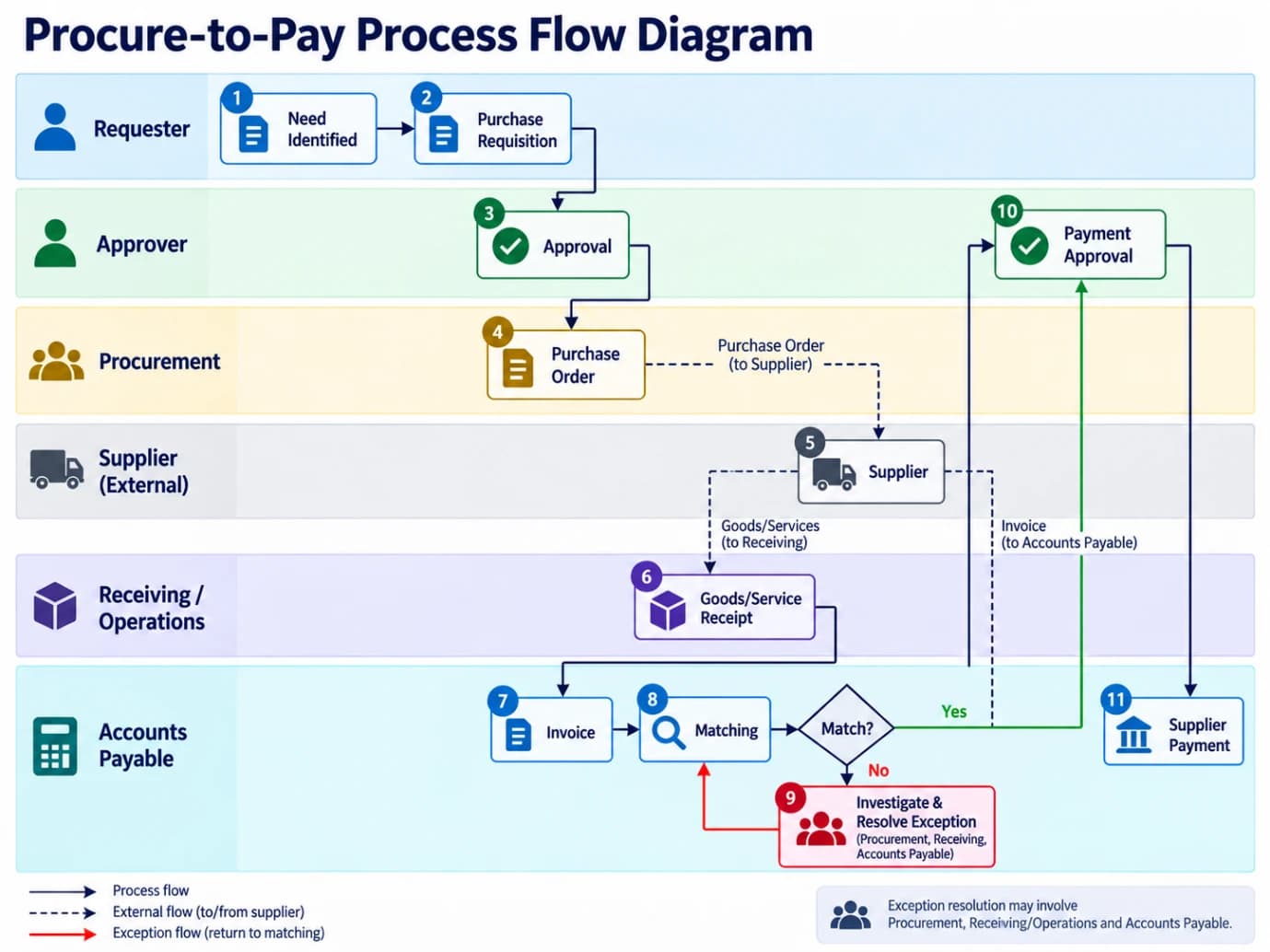
Need → Requisition → Approval → Purchase Order → Receipt → Invoice → Matching → Payment
CIPS describes procure-to-pay as the process that links procurement activity from the beginning of acquisition through to final payment.
The boundary matters. Strategic sourcing, market analysis, tendering, supplier selection and contract negotiation generally sit within the broader source-to-pay or procurement lifecycle. The procure to pay business process focuses on executing an approved purchase correctly and controlling the transaction through to payment.
Accounts Payable is therefore part of P2P, not the whole process. In the same way, purchase to pay should be understood as a cross-functional workflow, not simply an invoice-processing activity.
Procure-to-Pay Process Flow: From Requisition to Payment
The procure to pay process flow should create a clear trail from an identified business need to a verified and authorised payment. These procure to pay process steps also show where responsibility moves between the requester, procurement, receiving teams and Accounts Payable.
Identify the Need and Raise a Purchase Requisition
Start by defining what is required, including the specification, quantity, required date, budget or cost centre where applicable, and the business reason for the purchase. The requester then raises a formal purchase requisition.
A need is not a purchase order. The requisition is an internal request for authority to proceed, and the organisation should avoid committing to a supplier before the appropriate approval is obtained. Informal requests made by email or telephone can weaken the P2P process if Finance only sees the transaction after the commitment has already been made.
Approve the Requisition and Create the Purchase Order
The requisition is checked against delegated authority, budget and any relevant supplier or contract requirements. Once approved, procurement converts the authorised requirement into a purchase order stating quantities, agreed prices, delivery requirements and key commercial terms.
A purchase requisition is therefore an internal request; a purchase order is the formal purchasing document issued to the supplier. Clear role separation also matters — the person requesting a purchase should not automatically control every approval, receipt and payment decision. A RACI matrix can help clarify responsibilities across these hand-offs.
Receive the Goods or Confirm the Service
Delivery must be independently recorded before the invoice is treated as evidence that the obligation has been fulfilled. For goods, this may include quantity received, date and visible discrepancies. Services may require a milestone approval, timesheet, completion certificate or formal service confirmation.
Accurate receipt records are an important P2P control before invoice processing.
Receive and Validate the Supplier Invoice
Accounts Payable checks the supplier, invoice and PO references, amounts, duplicate risk and relevant payment terms.
Invoice validation is not yet payment approval.
The invoice must still be matched against what was authorised and what was actually received.
Match the Invoice and Resolve Exceptions
Invoice matching compares the supporting documents within approved tolerances. If the price, quantity or receipt does not agree, the transaction becomes an exception requiring investigation.
Examples include missing receipts, partial deliveries, price differences, duplicate invoices or unconfirmed services.
An exception should trigger investigation, not an informal workaround.
Authorise Payment and Complete the Transaction
Once the invoice is valid and any exception is resolved, payment is authorised, scheduled according to agreed terms, executed and recorded.
A complete end-to-end procure-to-pay process finishes only when the transaction is authorised, matched or resolved, paid and recorded.
Its data can then support supplier performance analysis, spend analysis and wider procure to pay process improvement.
This procure-to-pay process flow diagram shows how responsibility moves across functions from requisition to supplier payment. For a broader method of visualising hand-offs, decisions, ownership and exceptions, see our guide to process mapping.
How Three-Way Matching Works in Procure-to-Pay
Use three way matching to confirm that what was ordered, what was received and what is being invoiced are consistent before payment is released. In a 3 way match, three records are compared:
This is the core of three way matching in accounts payable because it adds receipt evidence to the invoice and purchase-order check.
| Check | Purchase Order | Receipt | Invoice |
|---|---|---|---|
| Item/service | Authorised | Received/accepted | Billed |
| Quantity | Ordered | Received | Billed |
| Price | Agreed | — | Charged |
| Supplier | Approved supplier | Delivered by | Billing entity |
For example, if the PO is for 100 units, only 80 are recorded as received and the invoice requests payment for 100, the three way invoice matching process should stop automatic payment and investigate whether there is a partial shipment, an incomplete receipt record, an invoicing error or an agreed contractual tolerance.
A mismatch does not automatically mean fraud or supplier failure. The purpose of the 3 way matching process is to expose differences before payment, so the organisation can resolve them using evidence rather than assumption.
Procure-to-Pay Controls: Where Errors Should Be Stopped
Design procure to pay controls around the points where an error, unauthorised commitment or invalid payment can still be prevented. Effective procure to pay internal controls should not rely on Finance detecting problems only after the transaction has already progressed.
| Stage | Main Risk | Practical Control |
|---|---|---|
| Requisition | Unnecessary or unauthorised spend | Business justification and approval thresholds |
| Supplier / PO | Wrong supplier, price or terms | Approved supplier or contract and authorised PO |
| Receipt | Payment for goods or services not received | Independent receipt or service confirmation |
| Invoice | Duplicate or inaccurate invoice | Invoice validation and duplicate checks |
| Matching | PO, receipt and invoice do not agree | Two- or three-way matching with defined tolerances |
| Payment | Incorrect or fraudulent payment | Segregated payment approval |
| Records | Weak audit trail | Retain approvals, receipts, exceptions and payment evidence |
GOV.UK guidance on procure-to-pay controls similarly highlights the importance of valid purchase orders, accurate receipt records and invoice matching before payment.
Good P2P control is placed where an error can still be prevented, not only where Finance discovers it later.
Segregation of duties is central to that principle. The requester, approver, receiver, Accounts Payable team and payment authoriser do not always need to be five different people, but incompatible responsibilities should not sit with one person without appropriate oversight.
A RACI matrix can help clarify these cross-functional responsibilities and reduce gaps or duplicated authority across the P2P process.
How to Handle a Procure-to-Pay Exception
Handle a procure-to-pay exception by establishing what actually happened before changing records or releasing payment. Suppose the purchase order covers 50 equipment units at £200 each, the goods receipt records only 45 units, but the supplier invoice requests payment for all 50.
The mismatch should not be resolved by asking Accounts Payable to adjust the transaction manually. Instead:
The invoice mismatch is only the visible exception. A controlled P2P process should also define who investigates it, what tolerance is acceptable, which evidence can resolve it and who has authority to approve an override.
Where the discrepancy concerns agreed price, delivery, acceptance or payment terms, refer back to the contract management lifecycle. Otherwise, repeated exceptions can easily become informal email chains rather than controlled decisions.
Common Procure-to-Pay Failures and What They Reveal
Common procure-to-pay failures often point to weaknesses in process design, not just isolated mistakes. Typical warning signs include:
The key is to ask what each failure reveals. Repeated non-PO invoices, for example, may indicate employee non-compliance, but they may also show that the approved purchasing route is too slow or impractical for legitimate operational needs. Likewise, frequent matching exceptions may point to weak supplier data, poor receiving discipline or unclear ownership between functions.
If the organisation cannot trace a payment back to an approved need, authorised purchase, verified receipt and resolved invoice evidence, the P2P process has lost part of its control trail.
How to Improve the P2P Process Without Automating Waste
Improve the P2P process by fixing weak workflow design before adding more technology. Effective procure to pay process improvement usually follows a practical sequence:
These procure to pay best practices improve both control and flow. Performance measures should also link to wider operational KPIs rather than becoming isolated procurement metrics.
Automation should remove avoidable manual work; it should not make a poorly designed approval chain move faster.
Used this way, procure to pay automation supports a better process instead of hiding its weaknesses.
Strengthen Procure-to-Pay Capability with LOTC
Strengthen procure to pay performance by building capability across both the purchasing and Accounts Payable sides of the process.
LOTC's Fundamentals of Supply Chain Management course covers the procurement process from need identification through to supplier payment, providing a strong foundation for understanding the wider P2P cycle.
For teams working more directly with invoices, matching and payment controls, Accounts Payable: From Fundamentals to Management develops practical capability in purchase orders, receiving reports, three way matching, approval workflows, exception handling, internal controls and AP performance measures.
To discuss the most suitable training option for your team, contact LOTC on WhatsApp.